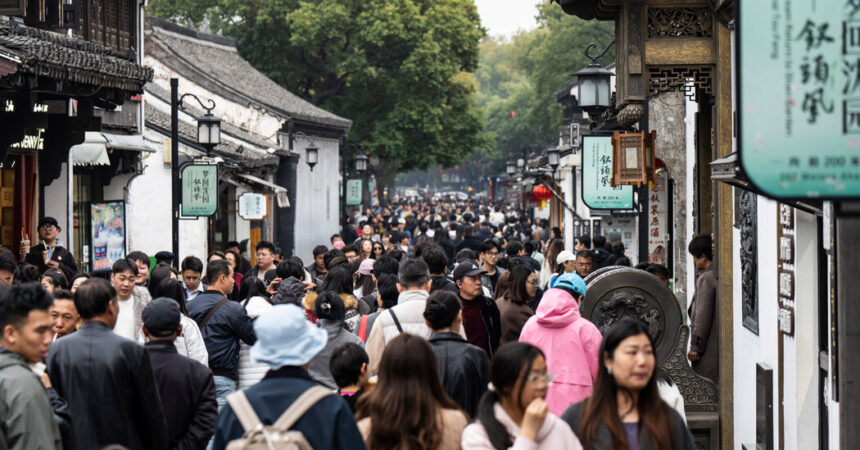
China’s consumer spending faced a significant setback in May, as retail sales unexpectedly dipped 0.6 percent compared to the same month last year, according to the National Bureau of Statistics. This marks the first year-over-year decline since December 2022, when a surge of COVID-19 infections confined consumers to their homes after the abrupt lifting of the country’s stringent “Covid zero” policies.
Analysts had anticipated that rising energy prices would stimulate retail sales, particularly given that gasoline sales influenced by higher fuel costs had increased, especially following the closure of the Strait of Hormuz. However, the actual retail sales figures did not exhibit the expected gains. The data, not adjusted for inflation, suggested that when factoring in rising consumer prices, the decline in spending could have been even more pronounced.
In response to weak domestic demand, many Chinese companies are intensifying efforts in overseas markets. Exports surged to a record high of $376.8 billion in May, building upon an already strong performance in April, as reported by the General Administration of Customs. Additionally, industrial production showed resilience, buoyed by significant outputs in high-tech sectors, including electric vehicles.
Economics professor Zhu Tian from the China Europe International Business School noted that while China’s supply side remains robust—characterized by rapidly growing exports and stable industrial production—domestic demand continues to flag. Investment levels also declined in May, even when omitting the ailing real estate sector, indicating a lack of profitable expansion opportunities, particularly among private sector firms.
China’s trade surplus experienced a shift in May due to soaring oil prices that raised import costs. To mitigate the impact, the country reduced its oil imports. The current state of China’s economy, with its stark contrast between weak domestic demand and a growing dependence on foreign consumers, is expected to be a key discussion point at the ongoing Group of 7 summit in southeastern France. The European Union is considering measures aimed at limiting the influx of subsidized Chinese goods, while many Western economists posit that the renminbi is undervalued.
Mark Sobel, vice chairman and chief economist of the Official Monetary and Financial Institutions Forum, emphasized the importance of the G7 collaborating on strategies to address what some are referring to as “China Shock 2.0.” He highlighted the need for pushing for significant appreciation of the renminbi.
In the automotive sector, car sales experienced a steep decline last month, largely attributed to a significant drop in gasoline-powered vehicle sales amidst increasing fuel prices. Total vehicle sales plummeted by 22 percent compared to the previous year, causing a noticeable impact on retail spending. Nonetheless, the downturn in car sales would have been more severe without the continued strength of electric vehicles and plug-in hybrids, which accounted for five out of every eight vehicles sold in China.
Industry executives remain cautious about the short-term outlook, noting that summer often sees diminished car sales, with recovery typically occurring around the national holidays in late September and early October. Cui Dongshu, secretary-general of the China Passenger Car Association, expressed concern that persistent weak consumer confidence, compounded by the ongoing struggles in the property sector, is likely to keep domestic demand under pressure.