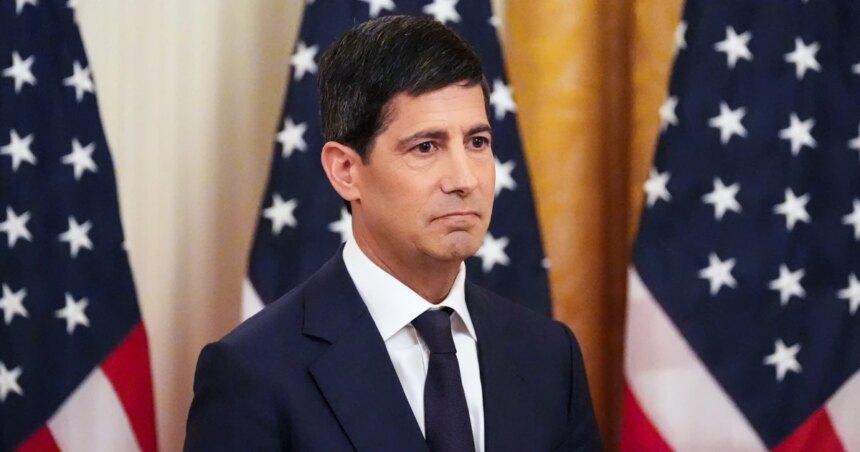
Rising inflation and the recent appointment of Federal Reserve Chairman Kevin Warsh are set to dominate discussions as the central bank convenes to deliberate on the future of interest rates. This pivotal meeting follows a tentative peace agreement between the U.S. and Iran, although it has yet to be formalized. Traders anticipate that the easing of oil prices will provide some relief for Warsh during his inaugural Federal Open Market Committee (FOMC) meeting.
Despite a notable 30% increase in oil prices since the beginning of the year, analysts predict that Warsh and the committee may opt for a rate hike by December in a bid to combat escalating inflation. Recent data revealed that wholesale business inflation exceeded 6% in May, while overall consumer inflation surpassed 4%, driven primarily by the energy shocks linked to tensions in Iran.
Earlier this year, President Donald Trump indicated that he would not have chosen Warsh for the post if he did not believe Warsh would swiftly lower interest rates. However, the broader economic landscape has shifted since that statement. Just recently, Trump told Warsh that he would have the freedom to pursue his own approach to interest rates. Currently, the Fed is not expected to alter rates during this meeting, as policymakers typically refrain from making changes in response to fluctuating energy prices. Most members of the FOMC are likely holding off on adjusting rates until the effects of the Iran deal on energy prices can be more accurately assessed over the coming months.
Even with no immediate changes to interest rates expected, the meeting will be closely monitored for hints regarding Warsh’s stance on inflation, rates, and the central bank’s overall strategy. Economists at UBS noted the significance of Warsh’s first press conference as Chair, labeling it a moment of considerable uncertainty. They surmise that the forthcoming statement could reflect heightened concerns about inflation.
An important aspect of the meeting will be the FOMC’s “dot plot,” a quarterly chart that indicates individual Fed policymakers’ expectations for the trajectory of interest rates over the next several years. This chart is part of the central bank’s Summary of Economic Projections, which also provides forecasts related to inflation, unemployment, and economic growth—contextualizing the dots regarding interest rate expectations.
Since its introduction in 2007, the dot plot has been a component of the Fed’s communication strategy, offering investors insight into future monetary policy. Warsh has previously asserted that the Fed tends to provide excessive forward guidance, suggesting that some of this practice should be scaled back. Such sentiments are echoed by former Fed Chair Jerome Powell, who expressed his reluctance towards the dot plot while highlighting its necessity as a communication tool.
Bank of America economists speculated that the dot plot would indeed be released after the meeting, although they believe Warsh may choose not to provide specific forecasts. They caution that a decision to discard forward guidance could provoke dissent among colleagues, especially after Powell’s review found little support for such changes.
Goldman Sachs analysts also share this perspective, predicting that Warsh may refrain from offering dot projections due to his criticisms of forward guidance. The previous dot plot indicated a consensus among Fed officials for only a single rate cut in 2026. However, analysts suggest that the current economic climate—marked by persistent inflation and a robust labor market—could lead to adjustments in the expected path of rates.
The variations in projections raise questions about the efficacy of forward guidance, which can often become obsolete as economic realities shift. Although criticized, many supporters argue that forward guidance remains vital for enhancing transparency and assisting investors, businesses, and consumers in understanding the central bank’s outlook on the economy.
As the market anticipates how Warsh will navigate the complexities of inflation and interest rates, all eyes will be on the FOMC’s forthcoming decisions and statements that may shape the economic landscape in the months ahead.