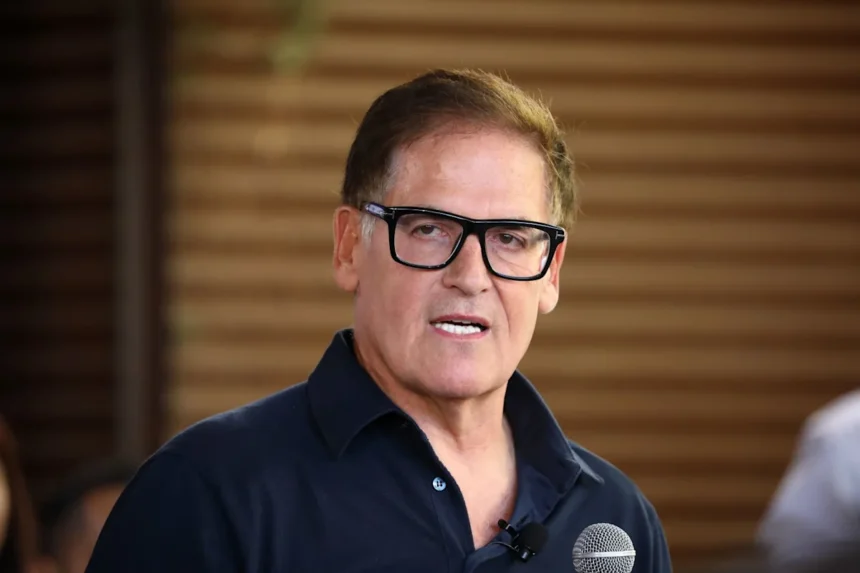
Elon Musk achieved a significant milestone earlier this month with SpaceX’s initial public offering (IPO), propelling his net worth beyond the $1 trillion mark. This event has reignited discussions surrounding the wealth of billionaires, drawing notable critiques from various quarters. However, entrepreneur Mark Cuban offered a different perspective, highlighting the interconnectedness between billionaire fortunes and the broader populace’s investment behaviors.
In a post on X, Cuban pointed out that the excessive wealth of individuals like Musk is largely attributable to the decisions made by millions of Americans to engage with the stock market. He emphasized that the very existence of billionaires is not solely an individual phenomenon, but rather a reflection of collective choices made by around 150 million Americans who invest in stocks, either directly or through retirement plans, mutual funds, and exchange-traded funds (ETFs).
Cuban’s stance underscores that stock ownership has wider implications than just enriching a small number of individuals. According to recent Gallup data, approximately 58% to 62% of U.S. adults own stocks in some form. For many families, stock ownership occurs indirectly through mechanisms like 401(k) plans or IRAs, making it a foundational element in wealth accumulation over time.
He articulated the significance of these investments in shaping public narratives surrounding billionaire wealth. Cuban stated, “One Hundred Fifty Million Americans. About 60% of adults. Effectively believing that [Elon Musk] and many billionaires could make them wealthier and help them achieve a better life.”
Despite the broad engagement in the stock market, ownership is disproportionately skewed. The wealthiest 10% of Americans control approximately 87% to 90% of stock market wealth, while the bottom half holds a mere 1%. Nonetheless, Federal Reserve data illustrates that stocks represent roughly one-third of U.S. household financial assets. While only about 21% of families own individual stocks, broader ownership rises markedly when including retirement accounts and investment funds.
This extensive market participation hints at the far-reaching consequences of market fluctuations on the average American family. Market upswings can enhance retirement savings and college funds, while prolonged downturns can severely degrade financial stability. Cuban warns that if collective sentiment swings toward divesting from stocks, the repercussions would be catastrophic—not only diminishing billionaire wealth but also crippling the savings of millions of Americans.
He remarked, “If you want [Elon Musk] and most billionaires to no longer be that rich, convince those 150m to sell their stocks, funds, ETFs whatever.” According to Cuban, such a mass exit from the stock market could result in significant financial turmoil, potentially triggering an economic collapse comparable to the Great Depression.
Cuban’s comments serve as a stark reminder of the complexities of wealth creation within public markets. Not long ago, SpaceX was a venture confronting immense risks in a sector predominantly occupied by government entities and established defense contractors. Early investors who believed in its potential were ultimately rewarded as the company evolved.
Contemporary investment interests are similarly focused on emerging sectors, including artificial intelligence, biotechnology, and renewable energy. Investors are betting on the next groundbreaking firm, contributing to the larger narrative of wealth generation.
Cuban’s perspective resonates with the reality that billionaire fortunes frequently emerge not just from individual actions but from the broader mechanisms of the market driven by millions of investors seeking value and financial security. Thus, the conversation about billionaire wealth, as Cuban asserts, is intrinsically linked to the millions who contribute to the economic ecosystem while striving to improve their own financial futures.