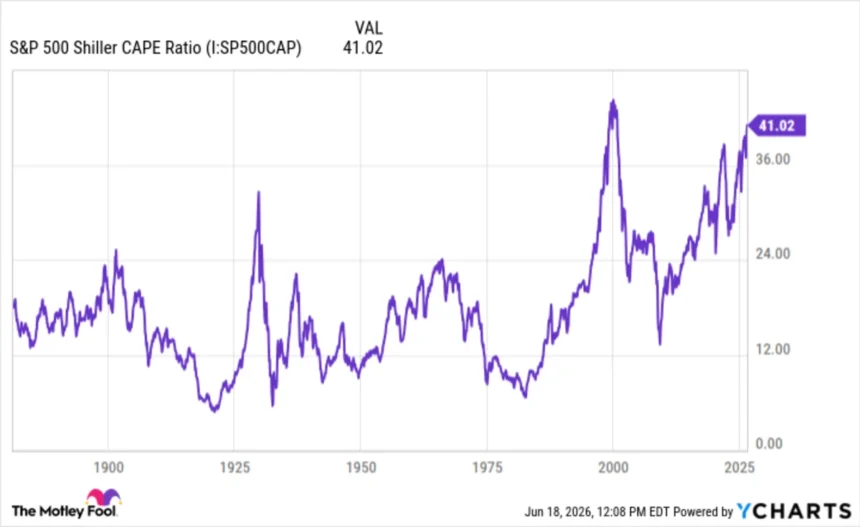
Despite ongoing pressures from persistent inflation and evolving interest rate expectations, the S&P 500 has seen a notable increase of 9.6% in the current year. This upward trajectory has been largely driven by strong investments in artificial intelligence infrastructure and resilient corporate earnings growth.
However, as the index climbs, there are concerns regarding valuations, particularly highlighted by the cyclically adjusted price-to-earnings (CAPE) ratio, which has reached its highest point since the dot-com bubble. The CAPE ratio, which measures the S&P 500’s valuation by comparing current prices to the average inflation-adjusted earnings over the last decade, serves as an important indicator. Historically elevated levels of this ratio have often predicted less favorable future returns, raising alarms about potential market adjustments.
With the CAPE ratio at such elevated levels, analysts caution that the disparity between stock prices and sustainable earnings growth may signal an impending correction or crash, compelling the market to realign towards more reasonable valuations.
To mitigate risks associated with a stock market downturn, financial experts recommend that investors evaluate their asset allocations and consider increasing their exposure to less volatile holdings. This strategy includes bolstering investments in bonds for income stability and defensive sectors such as utilities, healthcare, and consumer staples, which tend to perform better during economic downturns. Establishing a cash reserve can also provide a buffer during market turbulence, allowing investors flexibility to avoid selling stocks at a loss and to capitalize on buying opportunities.
Investors are advised to adopt a long-term perspective, implementing protective measures like predetermined stop-loss orders to minimize potential losses. This move can facilitate a shift towards higher-quality investments in more stable companies. Employing dollar-cost averaging strategies in high-confidence blue-chip stocks can also help maintain investment discipline through market fluctuations, reinforcing the notion that corrections are a routine part of the investment landscape.
For those contemplating investments in the S&P 500 Index at this time, it may be prudent to consider alternative opportunities. Analysts from a prominent investment advisory service have identified ten stocks that are poised for long-term growth, suggesting that these may yield superior returns compared to the S&P 500 at present. Historical performance of past recommendations, including Netflix and Nvidia, highlights the potential profitability of such investments, which have significantly outpaced the S&P 500 over time.
As investors continue to navigate an unpredictable market, comprehensive research and strategic planning become crucial to capitalize on emerging trends and safeguard assets against potential downturns.