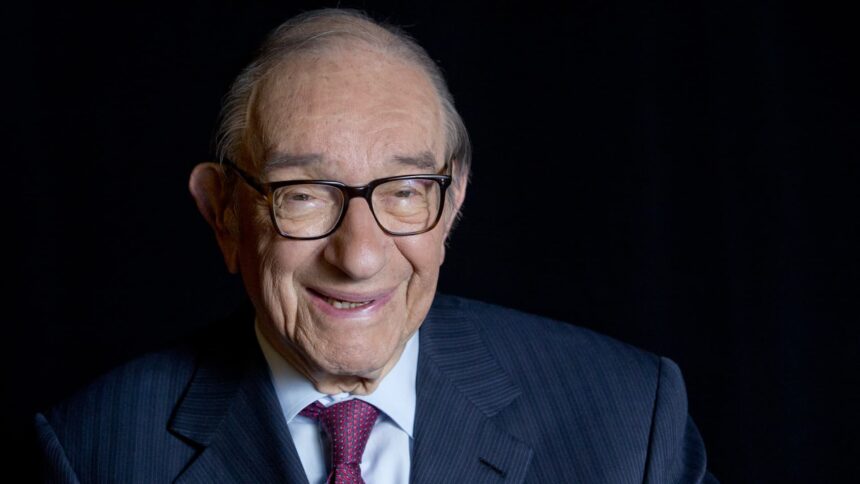
Alan Greenspan, the former Federal Reserve chairman renowned for his influential role in shaping U.S. economic policy, has passed away at the age of 100. His wife, Andrea Mitchell, a prominent NBC correspondent, confirmed that he died at their home due to complications from Parkinson’s Disease. In a heartfelt statement, she described him as “a giant of a man” who “helped shape the U.S. economy for decades under presidents of both parties,” acknowledging both his significant contributions and his honesty in admitting mistakes.
Greenspan was appointed Fed chairman in 1987 by President Ronald Reagan and maintained the position until his retirement in 2006, marking one of the longest tenures in the role. His time in office spanned numerous economic cycles, and he became known for his unique communication style, which often left even seasoned economists perplexed.
One of his most notable moments came in December 1996, when he cautioned about “irrational exuberance” in the markets during a speech that rattled stock prices both domestically and internationally. Although the markets eventually stabilized, this phrase became a hallmark of his tenure and a reflection of his cautious approach to economic policy.
Greenspan’s career began in the 1970s with roles in various economic advisory positions, including serving under President Gerald Ford’s Council of Economic Advisers. He gained prominence for his handling of the 1987 stock market crash known as “Black Monday,” where he assured markets of the Fed’s readiness to provide liquidity. This bold response helped restore confidence quickly, earning him the nickname “Maestro.”
Despite his successes, his policies faced criticism, particularly for their role in creating conditions that led to the Great Recession. Greenspan, who had advocated for low interest rates to stimulate homeownership, later acknowledged that he had underestimated the risky lending practices that proliferated during his chairmanship.
Born in New York City in 1926, Greenspan had a diverse background that included a passion for music; he played the clarinet and saxophone and briefly attended Juilliard before pursuing a career in economics. Educated at New York University, he earned his bachelor’s and master’s degrees, followed by a Ph.D. in economics.
In addition to his significant economic career, Greenspan often navigated the complexities of Federal Reserve communication, employing a style described as “purposeful obfuscation.” He believed this approach allowed him to address questions without revealing the Fed’s strategic decisions.
Following his time at the Fed, he established his consulting firm and later became a sought-after commentator on economic matters. He did not shy away from expressing his opinions on subsequent administrations, offering both praise and criticism of various presidents and their economic policies.
Greenspan’s personal life included a marriage to journalist Andrea Mitchell in 1997, alongside his early marriage that ended shortly after. Mitchell spoke of Greenspan’s passion not only for economics but also for sports and music, reflecting a multifaceted life.
As the economy continues to evolve, Alan Greenspan’s legacy as a pivotal figure in American economic history remains firmly etched. Despite the controversies and challenges of his career, his insights on monetary policy and market behavior will continue to resonate in economic discussions for years to come.