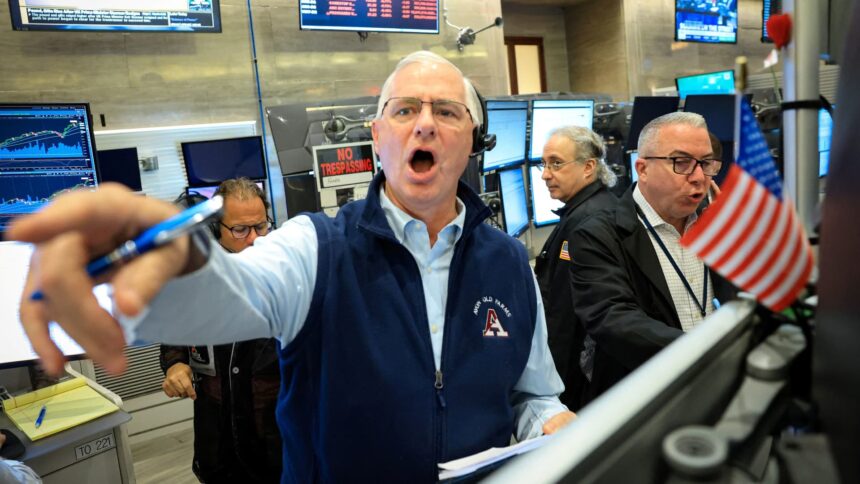
Futures-options traders worked on the floor of the New York Stock Exchange’s NYSE American (AMEX) as market activity showed mixed signals following a drop in high-profile technology stocks. S&P 500 futures were nearly flat, down 0.1%, while Nasdaq 100 futures slipped 0.2%. In contrast, futures linked to the Dow Jones Industrial Average saw a modest gain of 22 points, or less than 0.1%.
In Monday’s regular trading session, the technology sector led the way down, contributing to a 0.37% decline in the S&P 500. The Nasdaq Composite took a harder hit, falling by 1.32%. The Dow, however, managed to rise, thanks in part to strong performance from Caterpillar which surged by 148.01 points, or 0.29%.
As Asian markets prepared for Tuesday’s opening, there was cautious optimism among investors. The anticipated progress in U.S.-Iran negotiations played a role, with Japan’s Nikkei 225 futures indicating a potential gain. The Chicago futures contract showed an increase to 73,020, while Osaka’s futures were last trading at 73,090, compared to a previous close of 72,353.96. Similarly, futures for the Hong Kong Hang Seng index were up at 23,830 from its last close of 23,768.52, while Australian futures last traded at 8,831 compared to the S&P/ASX 200’s prior close of 8,816.10.
Investor sentiment reflected a notable rotation away from the “Magnificent Seven” tech stocks on Monday. Amazon experienced a nearly 5% decline, and Meta Platforms dropped by 2%. Alphabet’s shares fell 5%, marking their worst performance in over a year, as concerns arose about talent retention following the exits of key artificial intelligence researchers to rival companies.
Elon Musk’s SpaceX also suffered, falling 16% and marking its third consecutive negative session. Liz Ann Sonders, chief investment strategist at Charles Schwab, commented on CNBC’s “Closing Bell” that, while retail traders remain focused on the tech and AI sectors, they are showing less activity in individual stocks compared to previous trends. She noted a shift toward broader exchange-traded funds (ETFs) as preferred investment vehicles.
Sonders emphasized that corporate earnings remain a crucial foundation for stock performance in the current climate. In conjunction, oil prices took a downturn after a joint statement from mediating parties Qatar and Pakistan indicated progress in negotiations between the U.S. and Iran, with hopes for a finalized deal within 60 days. This includes a proposed committee formation and cessation of military operations in Lebanon. Following the U.S. Treasury Department’s decision to authorize the sale of Iranian oil through August, oil prices hovered near session lows.
As traders look ahead, Carnival and Korn Ferry are set to report their earnings before the opening bell on Tuesday. Additionally, investors will be closely monitoring preliminary S&P Global PMI readings for manufacturing and services in June, which are expected to provide further indicators of economic performance.