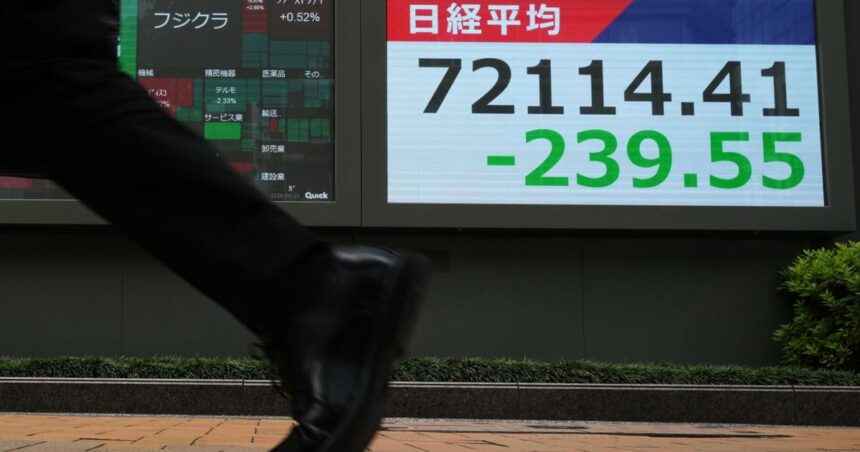
Asian financial markets experienced a downward trend on Tuesday as investor enthusiasm waned and concerns about efforts to resolve the ongoing conflict in Iran added to market uncertainty. Japan’s benchmark Nikkei 225 index dropped by 3.6%, concluding the day at 69,788.38. Neil Newman, Managing Director and Head of Strategy at Astris Advisory Japan, noted, “We’ve had eight days of strong markets. Now it has cooled off a bit.”
Australia’s S&P/ASX 200 index fell by 0.3% to 8,787.00 in afternoon trading, while South Korea’s Kospi decreased by 1.0% to 8,203.84. The Hong Kong market also took a hit, with the Hang Seng index sliding by 2.1% to 23,261.96, and the Shanghai Composite index losing 1.3%, down to 4,107.18.
On Wall Street, trading remained mixed on Monday as stocks fluctuated following a decline in oil prices along with a downturn in major technology stocks. The S&P 500 index decreased by 0.4%, marking its first decline in 12 days after a strong run, pulling 1.8% below its all-time high achieved earlier in the month. Meanwhile, the Dow Jones Industrial Average saw a slight gain, adding 148 points or 0.3%, whereas the Nasdaq composite faced a significant slump, down 1.3%.
Oil prices trended downward as discussions between the United States and Iran over the ongoing war progressed. U.S. Vice President JD Vance remarked that a “good foundation for a successful final deal” had been established. Ending the conflict could potentially reopen the Strait of Hormuz, a crucial avenue for oil tankers, thereby resuming oil deliveries from the Persian Gulf. However, Iran’s military claimed that they had closed the strait again, a statement that was disputed by U.S. Central Command.
On Tuesday, benchmark U.S. crude prices dropped by $1.14, settling at $72.72 per barrel, while Brent crude fell by $1.31 to $76.59 per barrel. The yield on the 10-year Treasury bond rose to 4.50%, up from 4.46%, driven by speculation regarding potential interest rate hikes by the Federal Reserve aimed at controlling inflation spurred by rising oil prices linked to the situation in Iran. Economists are anticipating an upcoming report indicating inflation for U.S. consumers increased to 4.1% in May, up from 3.8% in April.
In a notable decline, SpaceX shares fell 16.4% to $154.60, marking the company’s third consecutive drop following an initial surge after its market debut where stock was offered at $135 per share. The S&P 500 faced considerable pressure from major tech stocks, including a 5% decline for Alphabet, a 4.7% drop for Amazon, and a 4.5% decrease for Broadcom. Ultimately, the S&P 500 concluded the day down 27.79 points at 7,472.79, while the Dow Jones increased by 148.01 to 51,712.71, and the Nasdaq composite fell 351.33 points, closing at 26,166.60.
In the currency market, the U.S. dollar appreciated slightly, rising to 161.68 Japanese yen from 161.52 yen, while the euro decreased in value to $1.1426 from $1.1431.