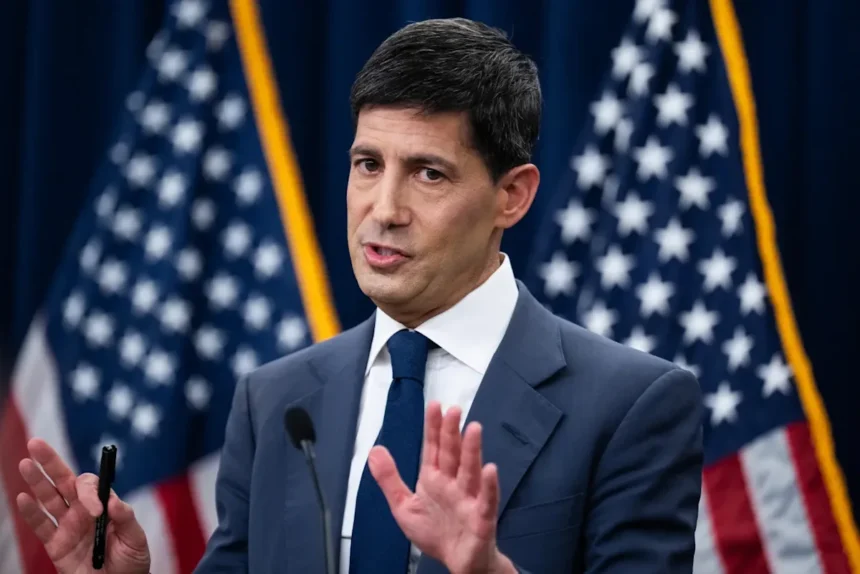
Bitcoin experienced a notable decline on Tuesday, dropping to a two-week low near $62,000 and reflecting a nearly 3% decrease within a single day. This downturn is tied to the market’s recalibration of expectations regarding a more hawkish Federal Reserve under the leadership of new Chair Kevin Warsh. Analyst sentiments remain divided over whether this dip presents a buying opportunity or marks the onset of a significant macroeconomic pullback.
The shift in market sentiment follows Warsh’s first meeting as Fed chair on June 17. The central bank maintained its benchmark interest rate within the 3.5%-3.75% range but signaled a notably hawkish pivot. The Fed revised its inflation forecasts for 2026, increasing the headline Personal Consumption Expenditures (PCE) estimate from 2.7% to 3.6%. Additionally, it eliminated any forward guidance in its statements, a departure from the norm that has raised eyebrows among investors.
In the wake of these announcements, markets have begun factoring in a greater likelihood of rate hikes, bolstering the U.S. dollar and real yields while placing pressure on safe-haven assets like gold and Bitcoin. Market participants are keenly awaiting the upcoming inflation figures, which could further influence investor behavior.
Currently, Bitcoin’s price hovers around $62,183, reflecting a nearly 3% decline in the past 24 hours. Retail sentiment regarding Bitcoin on platforms like Stocktwits has remained neutral, with social media engagement levels showing signs of lethargy.
Zach Pandl, the head of research at Grayscale, suggested that if fears around potential rate hikes subside, Bitcoin could regain momentum. He noted the disparity in performance among major macro assets, with U.S. stocks climbing roughly 9% since the onset of the Iran war in late February, while Bitcoin’s value has remained relatively flat, down about 1%. Pandl attributed this disconnect to the rising expectations for future hikes, which have increased by approximately 60 basis points during the same timeframe. However, Grayscale maintains a baseline expectation that the Fed will adopt a cautious stance moving forward, which could facilitate a rebound for Bitcoin if realized.
On the other hand, warnings from Robin Brooks, a senior fellow at the Brookings Institution, highlight the potential volatility ahead. He cautioned that Warsh’s decision to discard forward guidance may lead to instability in Treasury markets, driving long-term yields higher. Brooks likened the situation to the “taper tantrum” of 2013 when the 10-year yield surged sharply after the Fed signaled a tapering of bond purchases. Although he anticipates a milder reaction this time, he confirmed that it nonetheless points to erratic yield patterns, which could pose challenges for risk assets, including Bitcoin.
The historical context also raises concerns. Following the Fed’s taper signal in late 2021, Bitcoin saw significant declines the following year as aggressive rate hikes came into play. This situation reinforces the notion that the subsequent effects of monetary policy often carry heavier consequences than the initial shifts in guidance.
Analysts at Bitfinex have identified the price range between $68,500 and $72,000 as a significant point of resistance where recent buyers may be forced to offload if the price recovers. They noted that the overall realized price is nearing $54,000, serving as a deeper support level that remains untested. Currently, Bitcoin has dropped below its quarterly opening price of $68,266, with expectations that it may continue to fluctuate within the $60,000 to $70,000 range absent a significant driver for volatility.
The outlook is now increasingly contingent on forthcoming data. A future rate hike by the Fed seems more plausible unless inflation shows signs of cooling. The September Federal Open Market Committee (FOMC) meeting has emerged as a crucial date in determining the future trajectory of monetary policy and its prospective impacts on the market.