U.S. investors, often criticized for their short-sightedness, have seen this trait play out vividly in recent weeks. With the spotlight firmly on the U.S. market driven by massive gains from technology stocks and a surge in artificial intelligence investments, American indexes have climber to historic heights. Notably, the recent record-setting initial public offering showcased the continued dominance of the American market.
However, outside this concentrated bubble, especially in South Korea, the investment landscape paints a different picture. While the U.S. tech giants, referred to as the Magnificent 7, dominate headlines, South Korean semiconductor firms are making waves of their own. Companies like Samsung and SK Hynix have both crossed the $1 trillion market cap threshold, boasting staggering year-to-date gains of 196% and 354%, respectively.
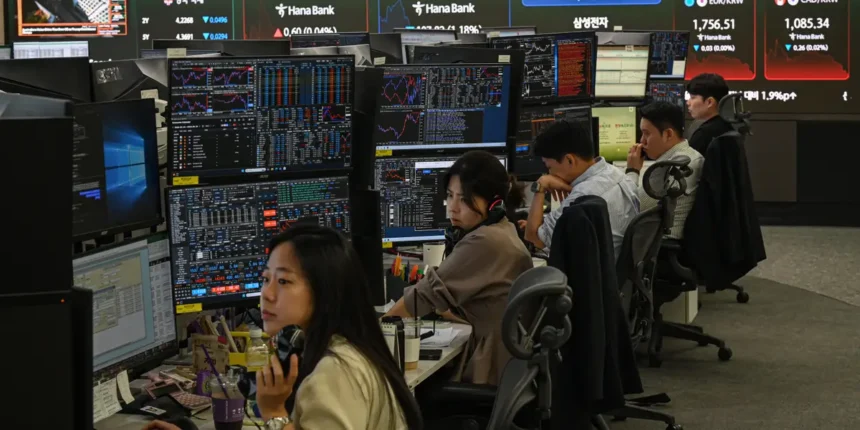
The explosive growth of these firms was starkly contrasted on Tuesday, when a dramatic market correction took hold. This downturn was triggered by a combination of factors, including apprehensions surrounding interest rate hikes in the U.S. and reports of SK Hynix scaling back production of advanced memory chips. This news caused a significant sell-off, culminating in a circuit-breaker stoppage and substantial declines — with both Samsung and SK Hynix witnessing losses exceeding 13%. The Korean Kospi index, which had seen remarkable growth earlier in the year, plummeted 10% by the session’s end.
In the United States, the repercussions were felt in the tech sector as the Nasdaq 100 slipped by 3.3%, and the Philadelphia Semiconductor Index saw a staggering 7.9% drop. The widespread impact on tech stocks illustrated the precarious nature of the current AI-driven market.
This incident has raised questions about the structural vulnerabilities of the AI trade, especially considering that even a relatively small player like SK Hynix can influence broader market sentiment. If a significant company within the Magnificent 7 were to face similar challenges, the potential ramifications could be severe, and investors are grappling with this unsettling thought.
Despite these developments, there are fundamental differences between the U.S. and Korean markets that may mitigate potential fallout. While Tuesday’s events demonstrated that Korean market movements can affect U.S. markets, the latter may be better equipped to handle such shocks. A significant contributor to the volatility in Korea is the high level of retail trading, with estimates suggesting that retail investors account for 50% to 70% of trading activities on any given day. In contrast, the U.S. retail trading percentage hovers between 20% to 25%. This discrepancy could lessen the contagion risk in the U.S. market compared to Korea.
Looking ahead, all eyes are on Micron, as the company is set to report earnings soon. Given the heightened sensitivity among traders regarding demand for chips and overall spending trends, any signs of weakness could significantly impact investor sentiment. With Micron shares already down by 13% in anticipation of potential disappointment, the pressure is mounting. Investors are left wondering if the future of the AI trade, indeed, hangs in the balance.