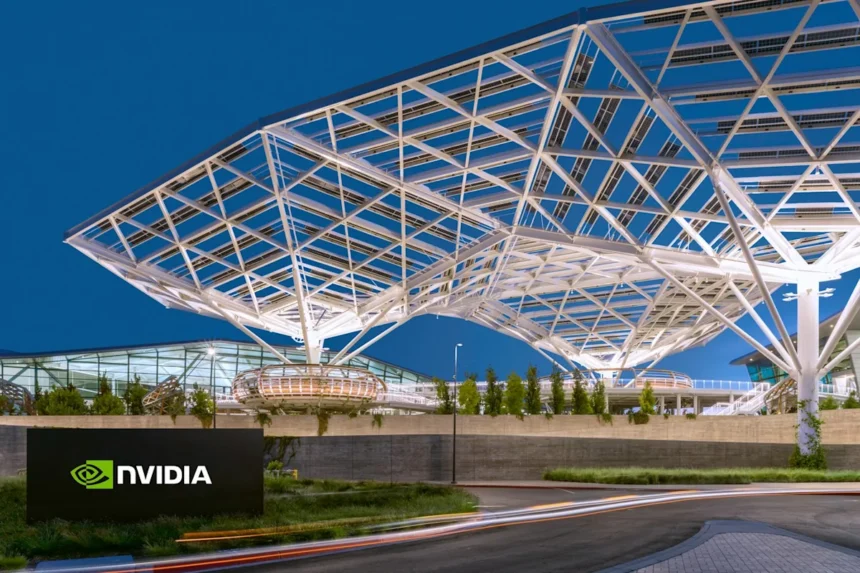
Nvidia has long been a leading name in the stock market, particularly during the AI boom that surged following the November 2022 release of ChatGPT. The company, which specializes in graphics processing units (GPUs) essential for artificial intelligence training, saw its stock skyrocket by more than 1,000%. This explosion in value positioned Nvidia as the most valuable company in the world, boasting a market capitalization nearing $5 trillion.
However, the enthusiasm surrounding Nvidia appears to have waned as of 2026. Investors have shifted their focus toward emerging chip bottlenecks in the industry, favoring memory chip stocks like Micron and Sandisk, which are grappling with shortages. Meanwhile, traditional CPU makers such as Intel, AMD, and Arm Holdings are also gaining traction due to heightened demand for AI inference technologies. Consequently, Nvidia’s stock performance has faltered this year, showing only a 4% increase compared to the S&P 500 and Nasdaq Composite, which recorded gains of 8% and 9%, respectively.
After peaking in May, Nvidia’s stock has fallen by 17%, despite the company’s financial performance continuing to impress. In its first quarter, Nvidia reported a staggering 85% revenue increase to $81.6 billion and a remarkable 139% boost in adjusted net income to $45.5 billion. Analysts predict that Nvidia’s net income may surpass $200 billion this year, a figure that rivals the GDP of some countries.
Despite its trailing adjusted earnings per share of $5.84, Nvidia’s price-to-earnings ratio stands at 33, slightly above the S&P 500’s 26. However, this evaluation doesn’t paint the complete picture when considering Nvidia’s explosive growth. Over the next three years, analysts project that Nvidia’s earnings per share could nearly double and potentially triple, leading to forecasts that suggest the stock could be trading at just 12 times expected earnings by fiscal 2029—a valuation typical of slow-growth stocks.
While these projections offer an enticing window into Nvidia’s potential, skeptics caution that predictions further into the future are increasingly uncertain. Much of Wall Street appears to have underestimated the sustaining power of the AI boom and Nvidia’s growth trajectory.
The discrepancy between Wall Street’s revenue predictions and Nvidia’s actual performance is stark. In 2025, expectations were that Nvidia would generate around $250 billion for fiscal 2027. Currently, it looks set to approach around $400 billion, indicating a notable underestimation of the firm’s growth.
The skepticism surrounding Nvidia’s stock value is rooted in concerns over the sustainability of its earnings. Historically, the semiconductor market has proven cyclical, and some believe that a slowdown in AI capital expenditure could lead to reduced demand for Nvidia’s products. This debate over the existence of an AI bubble has intensified, particularly in light of Micron’s recent earnings report highlighting ongoing shortages of memory chips, which could potentially amplify the demand for Nvidia’s offerings.
While the semiconductor industry may eventually face a peak cycle, the current valuations and market sentiment toward Nvidia suggest that potential risks have yet to be fully accounted for in its stock price. Observers believe that Wall Street has been too conservative, potentially missing out on the true upward potential of Nvidia’s growth.
Before considering an investment in Nvidia, investors might want to explore alternative stocks recommended by analysts, who have identified ten top picks for long-term growth opportunities. Following the proven track record of successful stock recommendations in the past may prove vital for those looking to navigate the current market landscape.