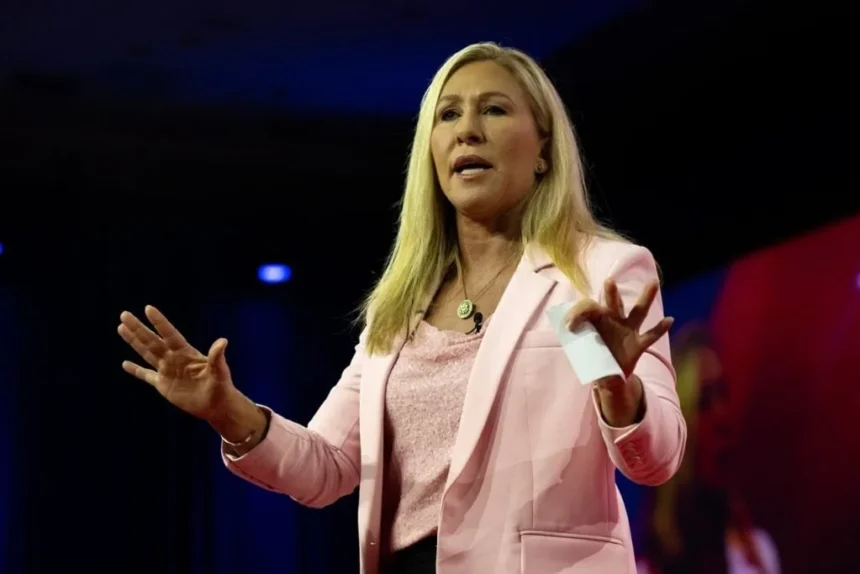
Former Representative Marjorie Taylor Greene has publicly criticized both the U.S. Supreme Court and former President Donald Trump following a recent ruling that favored Bayer AG in a significant legal battle regarding Roundup, a herbicide linked to cancer risks. The Supreme Court’s decision, which was passed by a vote of 7-2, curtails numerous state lawsuits claiming that glyphosate, the active ingredient in Roundup, causes cancer.
In her remarks, Greene expressed her discontent on social media, stating, “So the Supreme Court protects Monsanto and Trump protects glyphosate. But no one is standing up for cancer patients.” Her comments reflect a growing contention surrounding the chemical and its safety, especially as it relates to public health.
Bayer, which acquired Roundup as part of its $63 billion purchase of Monsanto in 2018, has encountered over 100,000 legal claims suggesting that glyphosate exposure can lead to cancer. The recent Supreme Court ruling overturned a $1.25 million jury award previously granted to John Durnell, who alleged that his non-Hodgkin lymphoma resulted from years of exposure to glyphosate.
In his statement, Justice Brett Kavanaugh indicated that the Environmental Protection Agency (EPA) has consistently concluded that glyphosate is not a cancer risk and has not mandated any cancer warnings on Roundup products. Bayer, responding to Greene’s criticism and the ruling, reiterated its stance that the decision reinforces the scientific consensus asserting glyphosate is “not likely to be carcinogenic.” The company highlighted that similar assessments have been made by regulatory agencies across Europe, Asia, and Latin America, often referencing an outdated 2015 evaluation from the International Agency for Research on Cancer.
Greene’s backlash towards Trump relates to his earlier actions in February, where he signed an executive order invoking the Defense Production Act to ensure domestic supplies of glyphosate-based herbicides, classified as crucial for national security and agriculture. Notably, Bayer is the sole U.S. manufacturer of elemental phosphorus, which is essential in producing glyphosate herbicides.
This ruling adds to a complex dialogue about glyphosate, intertwining legal, environmental, and health-related issues as stakeholders remain divided on its safety and governance. As the political landscape shifts, so does the conversation around industrial chemicals, public health, and the roles of different branches of government in regulating them.