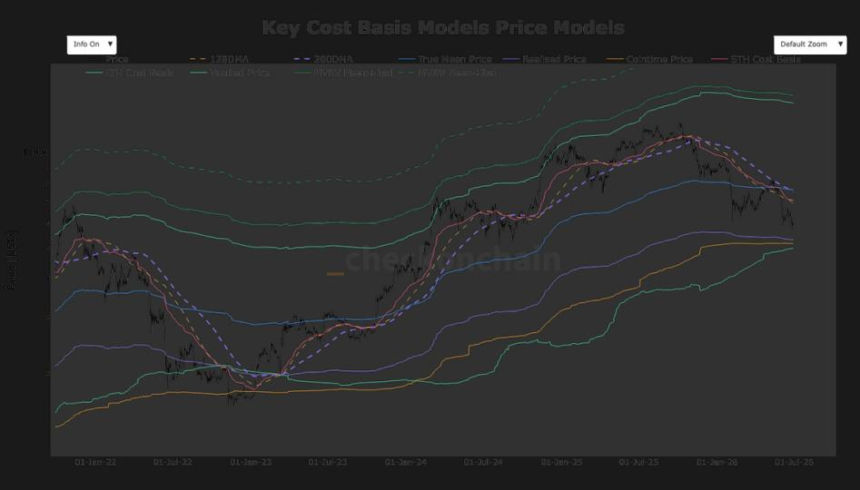
Bitcoin (BTC) is currently trading at approximately $59,858.96, hovering just below the critical $60,000 threshold, a situation often referred to as being in “no man’s land.” This term denotes a price range that lies between significant on-chain support and resistance levels. The cryptocurrency has struggled to reclaim several key technical benchmarks, indicating that the prevailing trend may be skewed toward a downward trajectory.
Several key valuation metrics are positioned above Bitcoin’s current price, drawing attention from traders and analysts alike. The True Mean Price, which stands at around $76,300, reflects the adjusted average acquisition cost of bitcoins, accounting for lost or inactive supply. This metric aims to provide a more nuanced understanding of the network’s economic cost basis.
Another significant technical benchmark is the 200-Day Moving Average, which is currently at $75,500. This widely followed indicator smooths price fluctuations over the past 200 days and serves as a crucial tool for distinguishing long-term bull and bear market trends.
In addition, the 128-Day Moving Average, priced at $70,900, tracks Bitcoin’s intermediate trends, offering insights into its performance over shorter periods. Meanwhile, the Short Term Holder Cost Basis, currently at $69,600, represents the average purchase price for investors who have held Bitcoin for less than approximately 155 days. This metric is critical in understanding short-term investor sentiment and potential future price movements.
As Bitcoin remains within this precarious price range, market sentiment may continue to be cautious, with investors closely monitoring these key indicators for signals of a shift in momentum.