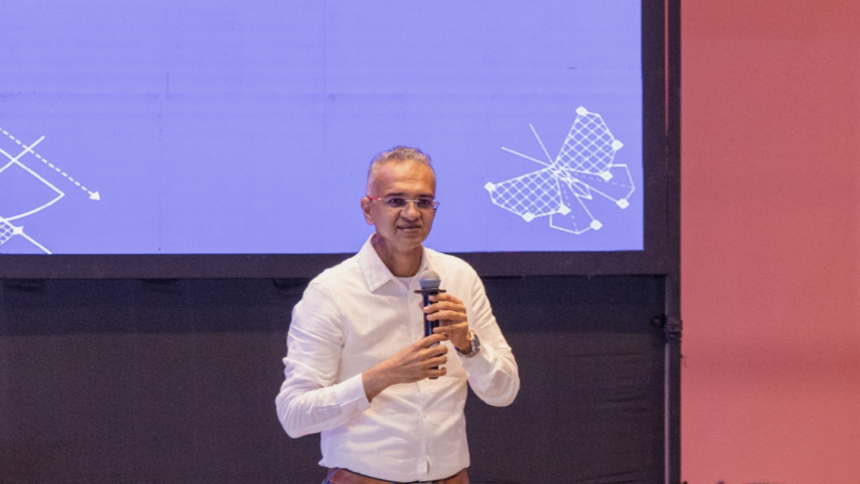
India’s digital payment landscape has experienced significant transformation, particularly with the Unified Payment Interface (UPI), which has surged to over 750 million daily transactions. The National Payments Corporation of India (NPCI), which oversees UPI, aims to escalate this figure to over one billion transactions daily. Dilip Asbe, MD and CEO of NPCI, highlighted the crucial role that artificial intelligence (AI) will play in achieving this ambitious goal, especially in user growth, fraud prevention, and credit distribution.
In a recent interview during Mumbai Tech Week (MTW) 2026, Asbe detailed his perspective on AI’s potential in enhancing UPI. He pointed out that AI can be instrumental in reaching new users, safeguarding existing users, and identifying fraudulent activities. Asbe emphasized the necessity of utilizing AI for credit distribution to users and merchants with digital footprints. “We must use AI to look at the voice and multilingual solutions to make onboarding simpler,” he remarked, illustrating the importance of accessible technology in enhancing user experience.
While the integration of voice interfaces into digital transactions has been discussed, Asbe believes that this feature is still in its infancy and requires further accuracy. NPCI had introduced a voice assistant-based interactive system in 2023, but its adoption has yet to spread widely. With the right use case, he sees voice technology becoming a vital element in the payment ecosystem.
The AI revolution in finance is not limited to India. In the U.S., both startups and established companies are rapidly incorporating AI into their financial services. For instance, platforms like Coinbase and Robinhood have begun allowing AI agents to trade on behalf of users, while OpenAI offers personalized financial advice through ChatGPT. Although NPCI has demonstrated some AI capabilities related to payments, as seen in its collaboration with Razorpay, a broader rollout has yet to occur.
Asbe advocates for robust regulations to pave the way for AI-powered financial solutions in India. He specifies that strong user protections and risk mitigation strategies must be in place. In cases where AI processes fail, it is crucial for the system to refer back to user permissions and instructions provided to the AI agents.
NPCI recognizes the value of developing small, localized language models tailored to the Indian ecosystem. “We have a very rich data set in our ecosystem,” Asbe stated. He believes this offers Indian banks and fintech companies the chance to create sharp and specific language models that deliver deterministic results.
In addition to these innovations, NPCI launched a model named FIMI last year, which addresses user disputes effectively by serving over a million users with functions like mandate cancellation and issue resolution, and is scaling rapidly.
Despite the push for competition, data indicates that UPI apps such as PhonePe and Google Pay dominate the market with over 80% market share. NPCI’s upcoming regulation aims to cap individual app market shares at 30% starting December 31, 2026, unless the deadline is postponed. Asbe indicated that the UPI ecosystem has low switching costs and shared core features, and that PhonePe and Google have invested heavily to secure their positions in the market. He noted that if newer apps can identify viable business models, they could gain share within the fintech space.
Asbe described NPCI’s initiatives to enhance the BHIM UPI app’s competitiveness since its spin-off, although its market share remains around 1%. NPCI is not setting specific market share targets for BHIM but aims to position it as a sovereign and secure alternative to other applications.
As India continues to evolve as one of the largest digital economies, global investors will be keenly observing the regulatory landscape to explore opportunities in emerging fintech solutions, thereby fostering increased competition in the market.