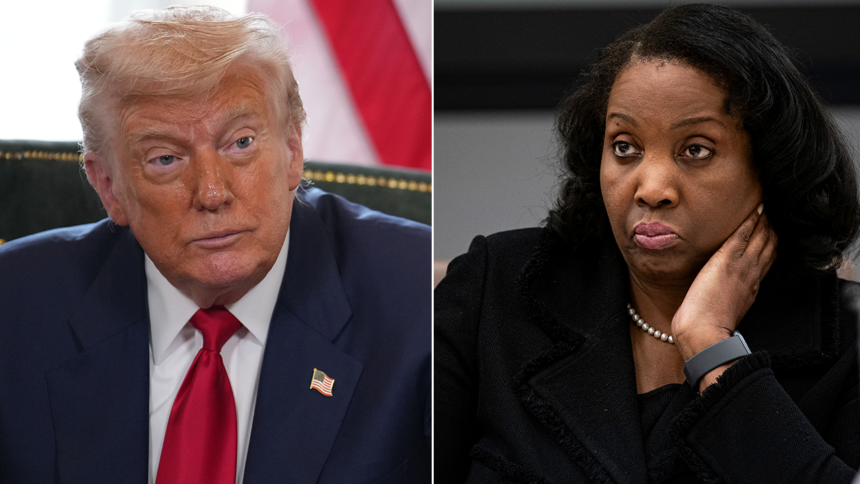
The Supreme Court has recently made a significant ruling regarding the appointment and removal powers of the Federal Reserve, delivering a notable victory for Federal Reserve Governor Lisa Cook amidst ongoing political scrutiny. In a closely divided 5-4 decision, the Court upheld a lower court’s ruling that preserves Cook’s position as she navigates a legal challenge against former President Donald Trump, who sought to remove her from the Board of Governors.
The crux of the ruling centered on whether Trump possessed the legal authority to dismiss Cook, a question that has broad implications for both the independence of the Federal Reserve and the presidential power over such independent agencies. Chief Justice John Roberts authored the majority opinion, supported by conservative Justice Brett Kavanaugh and the three liberal justices: Elena Kagan, Sonia Sotomayor, and Ketanji Brown Jackson. Conversely, Justices Clarence Thomas, Samuel Alito, Neil Gorsuch, and Amy Coney Barrett dissented.
This case is one of two pivotal Supreme Court matters addressing presidential removal power. The other case, Trump v. Slaughter, pertains to Trump’s firing of Federal Trade Commission Commissioner Rebecca Slaughter, where the Court reversed a key precedent established in 1935. While that decision weakened the restrictions on presidential removals, the ruling regarding Cook carved out specific protections for the Federal Reserve, indicating that its unique role and constitutional framework provide it with distinct autonomy compared to other agencies.
For the American public, the Federal Reserve’s capacity to act without political pressure remains critical. The Fed’s decisions directly impact crucial economic factors such as mortgage rates, job availability, and inflation management. In light of the ruling, Cook asserted that her case was rooted not in allegations related to past mortgage documents but rather in a politically motivated attempt to interfere with her work at the central bank. She hailed the decision as a reaffirmation of the Fed’s independence and pledged to continue making decisions grounded in evidence and the principle of sound economic stewardship.
The implications of this ruling come at a time when the Federal Reserve prepares to navigate its future under new leadership. Kevin Warsh, a former Morgan Stanley executive, is set to assume the role of Chair, raising questions about the ongoing balance of power between the executive branch and the central bank.
Cook’s conflict with Trump traces back to August 2025, when Trump publicly announced her firing, citing alleged misrepresentation regarding her mortgage applications prior to her appointment. Cook denied any wrongdoing and subsequently filed suit to challenge her removal. Early court decisions were in her favor, with a federal judge blocking Trump’s attempt while the case continued to unfold.
As the legal battle progressed, Powell’s attendance at the Supreme Court sessions marked a rare instance of a Federal Reserve Chair actively engaging in a legal dispute affecting the institution. He characterized the case as “perhaps the most important legal case in the Fed’s history,” reflecting the heightened stakes involved.
Additionally, Powell has faced scrutiny regarding his own conduct, with the Justice Department beginning a criminal investigation related to his congressional testimony on a major renovation project at the Fed’s headquarters. Powell has committed to remaining in his position until these issues are transparently resolved, which could further impact the functioning and leadership of the Federal Reserve.
This evolving scenario underscores the complicated interplay between politics and monetary policy, as the new leadership under Warsh aims to strengthen the Fed’s operations while ensuring that economic decisions remain insulated from political machinations. The potential consequences of this legal dispute for future Fed operations and broader economic policies remain to be seen as the situation unfolds.