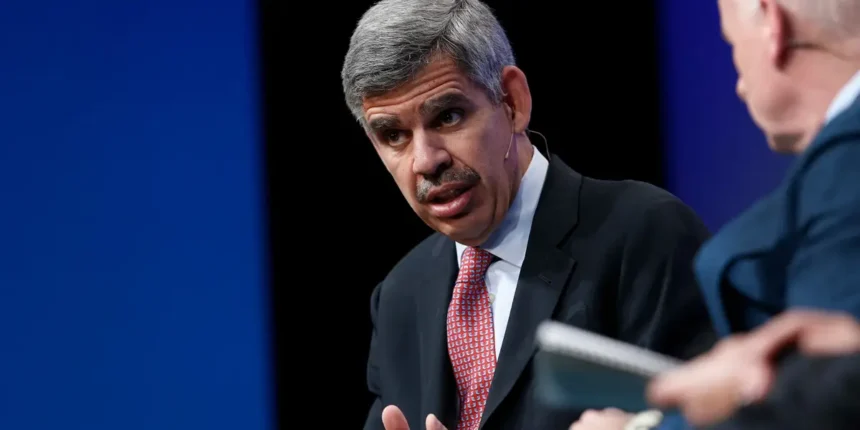
Prominent economist and investor Mohamed El-Erian has raised significant concerns regarding the current conditions in the U.S. stock market, citing two critical issues: inflated valuations and troubling technical indicators. Speaking with Yahoo! Finance, El-Erian emphasized that both aspects appear “out of whack,” signaling potential challenges ahead for investors.
He specifically noted the volatility impacting the artificial intelligence (AI) sector, particularly as investors have begun to shift away from high-performing semiconductor and memory stocks toward sectors that have not experienced the same degree of growth. The Roundhill Magnificent Seven ETF, which tracks seven leading companies at the core of the AI revolution, has seen a decline of over 10% in just the last month.
El-Erian expressed concern about the inflated valuations within the tech sector, especially as the AI buzz seems to be losing some of its momentum. He pointed to the Shiller CAPE ratio—an important metric that measures the market’s cyclically-adjusted price-to-earnings ratio—which is currently hovering near its all-time high. Notably, tech stocks within the S&P 500 have gained 15% this year, significantly outpacing the broader index’s 8% increase, further underscoring the valuation concerns.
In addition to valuation issues, El-Erian highlighted concerning technical signals in the market. A recent note from Bank of America indicated signs that the S&P 500 is becoming overstretched. This includes a divergence from momentum indicators and a technical “exhaustion signal” that was noted in June. El-Erian explained that when both valuations and technical signals appear misaligned, it poses trouble for the tech trade. He mentioned that there is considerable selling pressure in the sector, which compounds these issues.
El-Erian also warned of two potential risk scenarios unfolding in the market. The first involves the possibility of an imminent “air pocket” as investor priorities shift from merely building AI infrastructure to monetizing it effectively. He suggested that there may be a delayed reaction as investors come to terms with the reality of over-investment in AI. Reflecting on historical precedents, he referenced cycles of overenthusiasm, including 19th-century railroad mania and the dot-com bubble’s fiber optic rush. He predicted that certain data centers may fail to generate the returns anticipated, underscoring the potential pitfalls in the current AI frenzy.
Despite these warning signs, El-Erian argued that the current excitement surrounding artificial intelligence resembles a market bubble, albeit a “rational” one. He believes that successful companies emerging from the AI boom will ultimately offset inevitable losses within the sector. Furthermore, he asserted that for the future economic health of the United States, it is more beneficial to over-invest in AI than to under-invest, even if this may lead to short-term losses for investors.