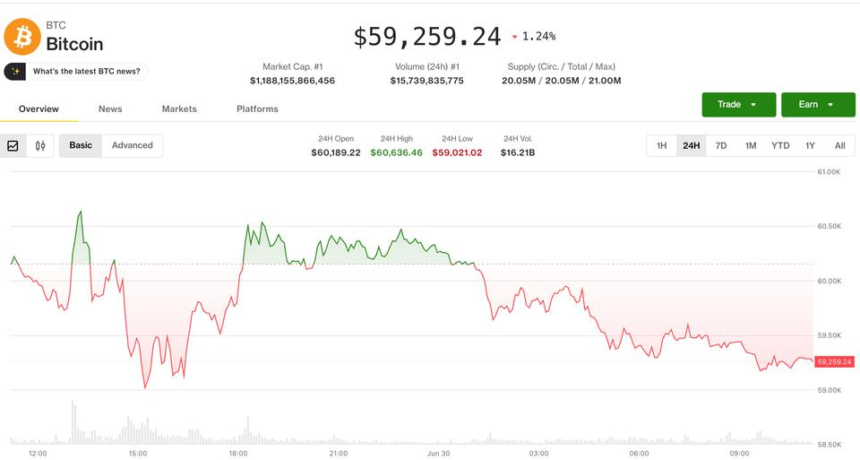
Bitcoin experienced a decline on Tuesday, dropping 1.5% to trade at $59,250 after failing to maintain its position above the $60,000 mark the day prior. This recent dip has put Bitcoin in a precarious position, as it is now approaching weekend lows of $58,800. Similarly, Ether is facing challenges, down 1.73% since midnight UTC and trading at $1,580. It too struggled to surpass the resistance level at $1,640. Both cryptocurrencies are now testing crucial multiyear support levels, with Ether having previously bounced back from this threshold in April 2025 and October 2023. With Bitcoin at its lowest level since late 2024, a failure to maintain support could leave both tokens without a clear floor.
In the altcoin market, there was a pronounced downturn on Tuesday, particularly with DeFi tokens such as ethena (ENA), jupiter (JUP), and ether.fi (ETHFI), experiencing declines between 3.3% and 7.5%. This retreat reflects a growing risk aversion among investors. In contrast, traditional markets showed relative stability, with U.S. equities maintaining steadiness since midnight. The S&P 500 and Nasdaq 100 futures recorded slight gains of 0.03%, while the Dollar Index (DXY) increased by 0.25%.
Among the notable trends in derivatives, HYPE, the native token for decentralized exchange Hyperliquid, defied the general downtrend by gaining over 4.3% in the past 24 hours. This movement appears to be driven by spot trading rather than stimulating interest in derivatives. Open interest for HYPE futures has remained stable at around 40 million tokens since June 22. Overall market positioning stays relatively light but leans bullish, indicated by annualized funding rates close to 10%, suggesting perpetual futures are trading above spot prices.
In a different part of the cryptocurrency landscape, DOGE, the largest memecoin by market value, saw its open interest soar to 16 billion tokens, marking its highest level since the crash on October 10. However, this influx appears bearish, with negative funding rates and a declining CVD (Cumulative Volume Delta) indicating stronger selling pressure among traders.
While Bitcoin, Ether, and XRP futures markets remained stagnant, with open interest confined within recent ranges, positioning for SOL has shown signs of potential volatility, nearing record highs. Volatility indexes reflected the market’s calm, with Bitcoin’s 30-day implied volatility dropping 11% to 44% and holding steady thereafter. Ether mirrored this trend, indicating a lack of significant market movement.
On Deribit, BTC puts were trading at a premium exceeding 10% compared to calls, highlighting ongoing concerns about potential downside risks. A similar pattern was observed with ETH, especially at the short end of the market, where weekly puts carried comparable premiums.
In token-specific trends, several native DeFi tokens struggled on Tuesday amid negative market sentiment. AI tokens such as FET, TAO, and RENDER also faced declines, along with privacy coins like zcash (ZEC) and monero (XMR). Despite the bearish trend affecting many altcoins, Stellar lumens (XLM) managed to maintain a bullish outlook following a significant announcement from DTCC, the largest U.S. financial markets clearinghouse. The clearinghouse plans to connect its tokenized securities platform to the Stellar network in the first half of 2027, leading to an impressive rally earlier in May.
Another token gaining traction is LIT, which has seen an uptick of 23% over the past week and notable gains of double digits in the past 24 hours. LIT, which operates as the native token of a decentralized perpetual exchange, mirrors HYPE in its performance, suggesting positive investor sentiment amidst widespread market challenges.