Charlie Munger famously identified three pitfalls that can lead to financial ruin: liquor, ladies, and leverage. It seems that the latter is currently relevant, especially in South Korea, where the stock market has experienced a dramatic surge, rising nearly 200% over the past year.
This meteoric rise has prompted widespread investor enthusiasm, leading to increased borrowing against securities. Data from the Korea Financial Investment Association reveals that the outstanding balance of margin loans surged to 36.3967 trillion won, marking an increase of 8.976 trillion won—approximately 33%—from the start of the year. Furthermore, loans secured by existing stocks and bonds also rose, reaching 25.9297 trillion won. Despite the challenges posed by collateral requirements, investors are actively pursuing additional purchases through strategies such as dollar-cost averaging.
Meanwhile, Taiwan’s market is not lagging behind, having also doubled in value over the past year. The allure of artificial intelligence has spurred a frenzy of investment, with individuals like 26-year-old Andy Cheng, who, despite being unemployed, has leveraged borrowed funds to amass a tech stock portfolio worth $60,000. His advice to potential investors resonates with many on the island: “Buy any stock and you will make money.”
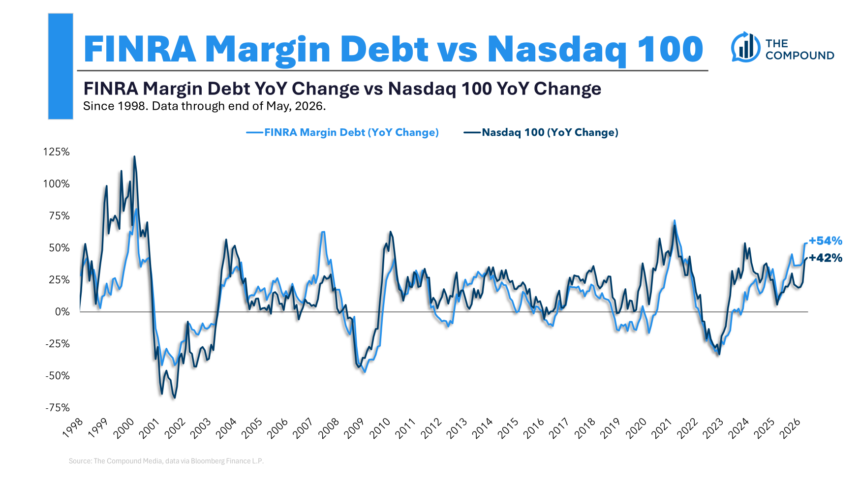
In the United States, the investment trend mirrors that of Asia. According to data from FINRA, U.S. margin debt rose by 54% to a record $1.4 trillion in May compared to the previous year. The market has witnessed a rapid increase in high-risk leveraged exchange-traded funds and options trading, indicating a significant appetite for risk among investors. It’s essential to note that these figures do not encompass various forms of leveraged trading, suggesting that the actual borrowing could be considerably higher.
While high margin debt is often concerning, its implications appear more relevant at a micro level than a macro one. The associated risks largely pertain to individual stocks rather than the overall market health. Current margin debt figures reflect stocks that have reached new highs. As such, if the stock market were to decline, margin debt would likely follow suit, and vice versa. The landscape remains precarious, especially for high-flying names such as SK Hynix, Samsung, and Micron, which have seen their stock prices surge between 150% to 700% this year.
Investors should remain cautious; substantial gains concentrated in a brief timeframe often lead to substantial down days amid the upward momentum. The volatility associated with leverage can translate into significant losses, particularly in cases of large sell-offs. This pattern intriguingly echoes events preceding the 1987 market crash when the market had climbed significantly only to face a steep downturn.
Although current levels of margin debt may evoke concern, they ultimately reflect a market riding high on the technology boom rather than signaling an imminent crash. However, overextension can jeopardize individual investors who misuse leverage. While higher margin debt levels may not single-handedly precipitate a market collapse, the risks they pose are undoubtedly significant, particularly in a climate characterized by rapid stock price fluctuations.