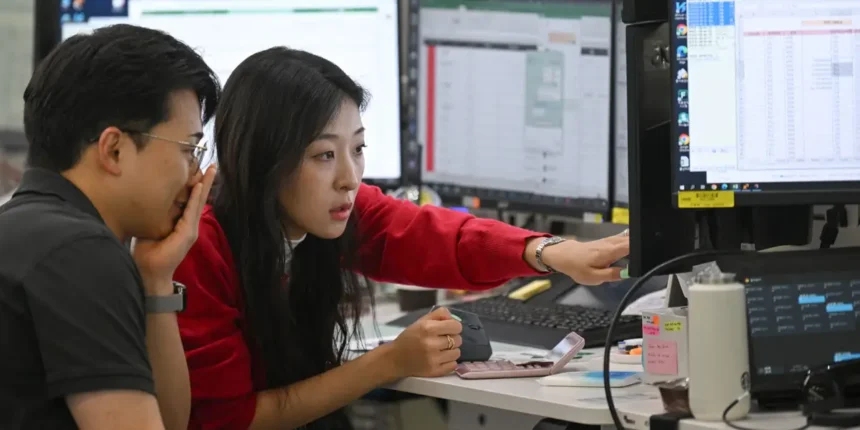
South Korea’s benchmark Kospi index experienced significant fluctuations on Thursday, heavily influenced by a downturn in US semiconductor stocks that spread across Asian markets. The index plummeted as much as 7%, with key players SK Hynix and Samsung Electronics witnessing declines of approximately 10% before recovering some of their losses. This selloff also impacted Japan, particularly with Kioxia, the country’s most valuable chipmaker, plunging over 15%, which contributed to a more than 2% drop in the Nikkei 225.
Market analysts suggest that this latest volatility may reflect less about the actual health of South Korea’s semiconductor sector and more about a natural pullback following a period of remarkable gains. Despite Thursday’s setbacks, both SK Hynix and Kioxia have seen substantial increases this year, climbing over 200% and 600%, respectively.
The South Korean stock market has emerged as one of the strongest performers globally in 2023, primarily driven by rising semiconductor and AI-related share prices. This ongoing rally has heightened the market’s vulnerability to abrupt corrections.
Interestingly, the bearish trends came even as demand for memory chips remains robust. On Wednesday, Morningstar upgraded its fair value projections for both Samsung Electronics and SK Hynix, with equity analyst Jing Jie Yu indicating that the ongoing memory upcycle is significantly surpassing initial expectations, thanks to tight supply and persistent AI demand that bolsters long-term earnings visibility.
However, a pressing concern among investors is how long the favorable pricing landscape can endure before new supply levels out. Yu noted that while memory valuations depend on pricing momentum, they are also influenced by the duration of these pricing conditions. Looking ahead, he anticipates a significant increase in memory supply over the next two years, which could lead to a downturn expected in 2029 and 2030 as long-term agreements expire.
The uncertainty in the semiconductor sector appears to be extending further, with predictions of increased volatility as markets await the release of the US nonfarm payrolls report later in the day. Furthermore, noticeable speculation has returned to the Japanese yen, as short positions have surged back to levels last observed in July 2024, a period marked by a significant currency intervention and subsequent Bank of Japan rate hike that triggered a major unwind of carried trades.