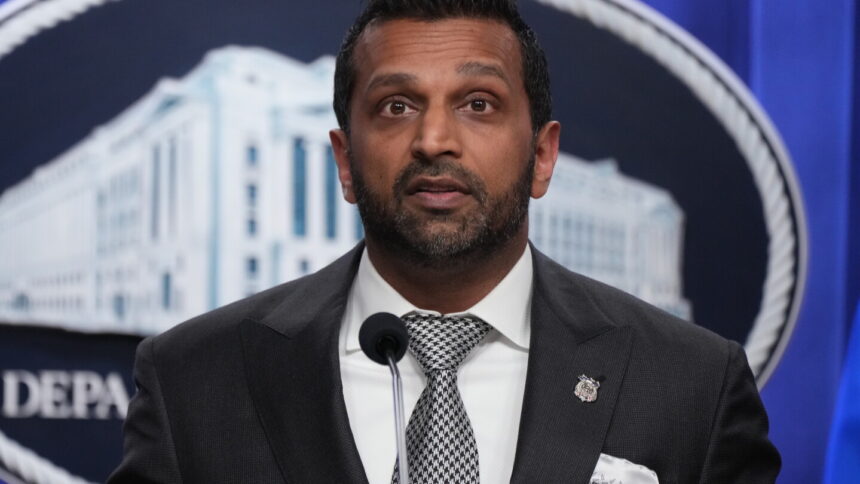
The recent financial dealings of FBI Director Kash Patel have raised eyebrows following his failure to disclose a significant stock purchase in a company tied to cryptocurrency. According to federal financial records, Patel acquired between $100,001 and $250,000 worth of shares in MicroStrategy, a business intelligence and mobile software firm known for its substantial dealings with the Department of Justice, on November 21. Despite the magnitude of the transaction, Patel did not report this trade until May 26, citing an “inadvertent omission” in earlier disclosure documents.
Under the Stop Trading on Congressional Knowledge (STOCK) Act, high-ranking executive branch officials are mandated to publicly disclose individual stock trades exceeding $1,000 within 45 days. First-time infractions carry a penalty of a $200 fine. MicroStrategy, which has styled itself as a “Bitcoin Treasury Company,” has engaged in millions of dollars worth of contracts with the Justice Department, where the FBI plays a pivotal role.
Patel’s involvement in cryptocurrency matters adds another layer to the case, as the FBI actively investigates cryptocurrency-related crimes, including investment fraud. Patel has publicly commended the FBI’s efforts in tackling crypto fraud, emphasizing the bureau’s commitment to justice. In posts on social media platform X, he has highlighted the FBI’s successes, including the seizure of $15 billion in Bitcoin linked to a global fraud network.
In response to the controversy, Deputy Assistant Attorney General William Taylor stated that Patel’s personal stock purchase does not conflict with his duties at the FBI. He described Patel’s delayed disclosure as the result of “miscommunication.” An FBI official also noted that the late reporting was unintentional and that, while the Department of Justice technically oversees fines for STOCK Act violations, no penalty has been levied at this time.
Patel’s late disclosure has reignited discussions about financial ethics among federal officials. Dylan Hedtler-Gaudette of the nonpartisan watchdog group Project on Government Oversight criticized the late filing, asserting that it constitutes a clear violation of the law. He, alongside many other advocacy groups and some congressional members, has been advocating for restrictions on stock trading by federal officials to mitigate potential conflicts of interest and the possibility of insider trading.
In terms of stock performance, MicroStrategy’s value has diminished significantly since Patel’s acquisition. Despite this, some financial analysts remain optimistic due to the company’s newly announced restructuring plan. Patel’s stock trading history has come under scrutiny before; in May 2025, he purchased stock in Krispy Kreme, which later fell into the spotlight due to lawsuits following a data breach that affected over 160,000 individuals. This breach also drew FBI attention when it linked to a ransomware group known as Play.
The events have provoked a broader dialogue about accountability and ethics in government positions, especially concerning financial disclosures.