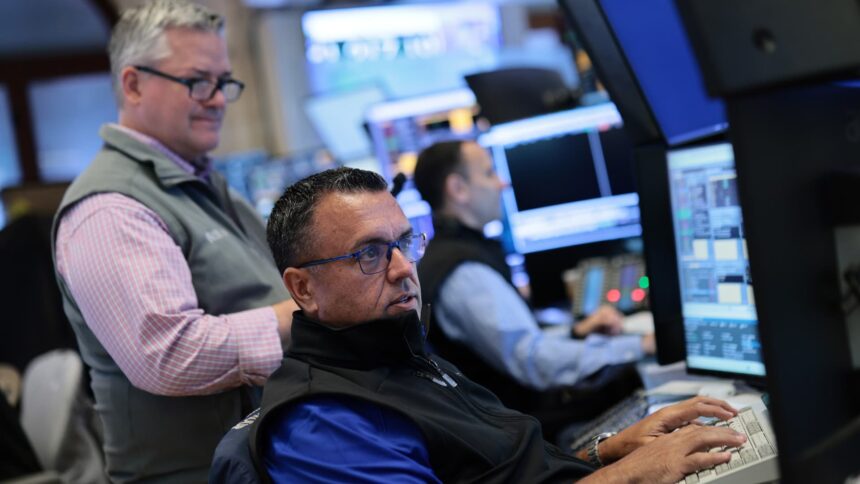
Traders were busy maneuvering on the floor of the New York Stock Exchange on July 1, 2026, as market conditions reflected significant shifts in investor sentiment. The Nasdaq-100 index, often viewed as a barometer for large-cap tech stocks, is currently experiencing a volatile phase, reminiscent of a hurricane, where the cost of hedging against market declines—symbolized by the rising price of put options—has surged dramatically.
Market analysts have noted a notable widening of the implied volatility spread between the Nasdaq-100 and the S&P 500. Currently, the one-month implied volatility for the Nasdaq-100 stands at 28, while the S&P 500 hovers below 16, marking one of the most significant disparities in years. This trend reflects a broader market dynamic where the returns increasingly hinge on a select few tech giants, diverging from the steadier performance of the S&P 500.
The recent fluctuations in the market have been driven by heightened demand for put options—contracts that give investors the right to sell at a specified price, safeguarding against declines. In stark contrast to earlier months, when call options (bets on rising prices) were in high demand, the current sentiment indicates a shift towards protective strategies as the technology sector shows signs of strain. The spread between the implied volatility of 25-delta puts—those with a one-in-four chance of profitability—in the Nasdaq-100 compared to the S&P 500 has spiked from just 3 points in mid-March to an alarming 13.6 today, according to data compiled by Bloomberg. This figure echoes past market turbulence, reaching similar levels last observed in 2008.
Kevin Davitt, head of index options content at Nasdaq, commented on the shift in market sentiment, noting that previously, investors were focused on potential price increases. “Nobody cared about puts back then, it was all about upside but now that sentiment has shifted,” he remarked, highlighting the growing apprehension among traders about the prospects for high-flying tech stocks.
This increasing demand for protective puts can be linked to a slowdown in momentum for artificial intelligence stocks, which had previously rewarded investors with consistent gains. A notable drop was observed in the semiconductor ETF (SMH), which fell 4.5%, dipping below $592, a level it had not reached since late May.
While the recent trend may indicate a rising temptation for bearish positions, it does not necessarily signal an impending crisis. Earlier in the year, strong call-buying activity had saturated the market, and even though the thirst for upside momentum has diminished, it remains significantly high. The prices for one-standard-deviation out-of-the-money calls on the Nasdaq—those with a 16% chance of expiring in-the-money—stand at a still-respectable 58th percentile, a decrease from the 99th percentile seen in May.
Adding another layer of complexity to the market are seasonal dynamics, especially the onset of summer. Scott Nations, president of Nations Indexes, explained that traders typically anticipate a lull in volatility for the S&P 500 during this time. However, the outlook for the Nasdaq-100 remains more uncertain, as expectations of continued volatility loom due to ongoing fluctuations within the tech sector.
With the markets on edge, all eyes will be on how tech stocks perform in the coming weeks, as traders navigate the shifting trends and prepare for the potential impacts of this uncertain atmosphere.