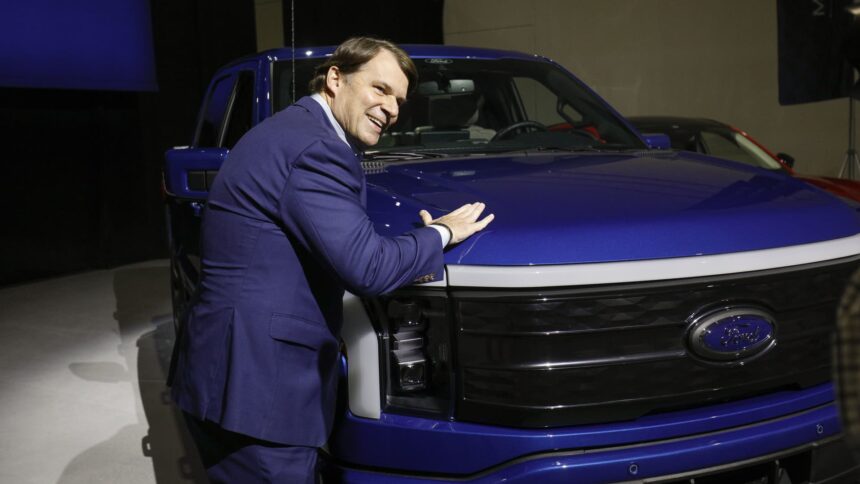
Ford Motor Company continues to position itself as a pillar of American manufacturing and truck leadership, notably with its best-selling F-Series pickups. However, the automaker has recently grappled with a troubling trend—vehicle recalls and quality issues—that have hampered its financial performance, eroded customer trust, and tarnished its reputation over the last decade. So far this year, Ford has announced 53 recalls affecting over 12 million vehicles, following a notable 153 recalls of approximately 13 million vehicles in 2025.
In an exclusive interview with CNBC, CEO Jim Farley expressed optimism regarding the company’s turnaround, emphasizing the lessons learned from past challenges. “Our best days are in front of us as we continue to execute this quality turnaround for our investors, for employees, for our customers,” he remarked, adding that an ambitious lineup of new vehicles set to launch in North America within the next few years necessitates a flawless execution.
Navigating new vehicle launches can be complicated, especially with the integration of emerging technologies such as software-defined systems and electrification. Farley is acutely aware of the financial toll these quality control issues have inflicted on Ford, costing the company billions during his nearly six-year tenure. Notably, Ford recently announced a recall involving 741,195 SUVs and F-150 trucks from model years 2018 to 2021, further underscoring the ongoing challenges it faces.
Investors have been closely monitoring these quality issues, as warranty costs—expenses that arise for repairs and replacements of defective parts—represent a significant risk to the company’s financial outlook. Ford reported a reduction of $1.5 billion in warranty and materials costs in 2025 and aims for continued improvements in 2026 to mitigate costs that had previously peaked at $4.8 billion in 2023. Barclays analyst Dan Levy highlighted this progress, stating, “We believe the 1Q warranty improvement is encouraging, yet believe further improvement will still be needed.”
In a noteworthy development, Ford was recently recognized as the top mass-market brand in the U.S. for initial vehicle quality by J.D. Power. This recognition marks the first time since 2010 that Ford has led in this area, with owners reporting fewer problems within the first 90 days of vehicle ownership. Not only did Ford move from its previous ranking of 23rd in 2023 to third overall, but it also surpassed major luxury brands like Toyota’s Lexus.
This achievement reflects a concerted effort by Farley and his team to enhance Ford’s operational structure, focusing on quality improvement and proactive identification of potential defects. Farley has initiated changes in executive compensation, aligning bonuses with performance metrics related to quality, thereby enhancing accountability among leadership.
Despite notable progress, challenges remain. Ford’s Lincoln brand, for instance, ranked below industry averages in J.D. Power’s U.S. Vehicle Dependability Study, signaling that further work is necessary to bolster long-term vehicle quality perceptions. Farley has resisted speculation on when Ford might shed its negative recall standing, acknowledging that it is influenced by historical issues in older models as well as competitive maneuvers in the automotive sector. He is, however, confident that ongoing initiatives will substantially reduce future recalls for both current and future vehicles.
Farley stated, “The ultimate success metric is will we do it over the course of five or ten years through launches, through all sorts of economic cycles.” This reframing underscores his belief that quality improvement is a long-term commitment and not merely a quick fix.
As Ford confronts these complex challenges, the automaker has made systemic changes designed to catch potential issues earlier in the vehicle development process. Key among these is an organizational restructuring that includes hiring 350 technical specialists and enhancing collaboration with suppliers. The company has also reinstated seasoned engineers to mentor younger staff and optimize the use of artificial intelligence in problem detection and resolution.
Farley remains determined in his commitment to quality, stating, “I know after 40 years how important quality is and durability is, and how difficult it is to be the best, which we now are initial.” He emphasizes that maintaining this momentum is essential, indicating that creating a quality-centric culture within Ford is paramount for its future success.