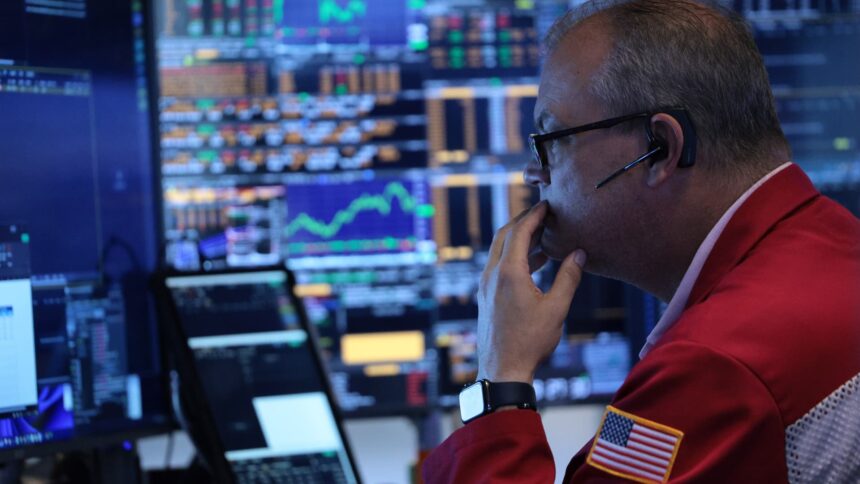
Wall Street entered the third quarter with a mix of outcomes following a robust first half of the year for stocks. The opening days of July saw the S&P 500 largely unchanged, while the Dow Jones Industrial Average reached record highs, contrasting with the Nasdaq, which faced consecutive losses.
The Dow concluded a holiday-shortened week at a record close on Thursday, buoyed by a softer job report that eased fears of an impending interest rate hike by the Federal Reserve. Meanwhile, the Nasdaq struggled, particularly within the semiconductor sector, which experienced significant declines—6.3% on Wednesday and 5.4% on Thursday as measured by the PHLX Semiconductor Index. Despite this trend, all three major indices recorded gains for the week, as July began with a shift towards new beneficiaries of artificial intelligence (AI).
The first half of 2026 proved remarkably fruitful for the stock market, with the S&P 500 gaining 9.6% and the Nasdaq rising over 12%. The Dow marked its most successful first half since 2021, rising 8.9%, while the small-cap Russell 2000 surged nearly 22%, making it the strongest start to a year since 1991.
Cybersecurity stocks stood out during the week, emerging as significant winners from the AI boom. This is a stark contrast to earlier concerns about AI disruptions. Following a report stating that Chinese AI models are nearing the capabilities of leading U.S. platforms in vulnerability identification, investors reassessed the needs for cybersecurity, interpreting the news as an impetus for increased spending in the sector. Major players like Palo Alto Networks and CrowdStrike saw substantial rallies, reaching all-time highs—Palo Alto’s shares jumped nearly 14.5% and CrowdStrike’s by 10.7%.
In another sector, Meta Platforms generated excitement among investors by signaling that its hefty AI investments may soon turn into tangible revenue. Shares of the parent company of Facebook and Instagram surged over 8% on news that it plans to launch a cloud infrastructure service focused on selling excess AI computing power and models to external customers. Meta’s growing apprehensions regarding capital spending in its data centers and AI infrastructure were somewhat alleviated; previously, investors were uneasy about the narrow, economically sensitive nature of its revenue streams. CEO Jim Cramer had already advocated for a cloud initiative, predicting that such a move would enhance the stock’s performance.
As portfolio managers continue refining their strategies, several adjustments were made within the CNBC Investing Club portfolio. Notably, the decision was made to sell Nike shares, as the anticipated turnaround took longer than expected. Proceeds from this sale were redirected into companies believed to exhibit cleaner growth potential. Also, positions in stocks like Corning were trimmed as they exceeded expected performance, despite remaining a favorite in AI infrastructure.
Additionally, investments were ramped up in FedEx and its recently spun-off subsidiary, FedEx Freight. The rationale included a belief that the market underappreciates FedEx’s evolving parcel business, benefitting from stronger demand across various sectors, including healthcare and automotive. Goldman Sachs echoed this view with a buy rating and a $186 price target for FedEx.
Investors in the CNBC Investing Club are kept informed of trade alerts, ensuring opportunities for strategy adjustments in real-time. However, it is emphasized that no guaranteed outcomes or profits exist in these transactions, reinforcing the unpredictable nature of market investments.