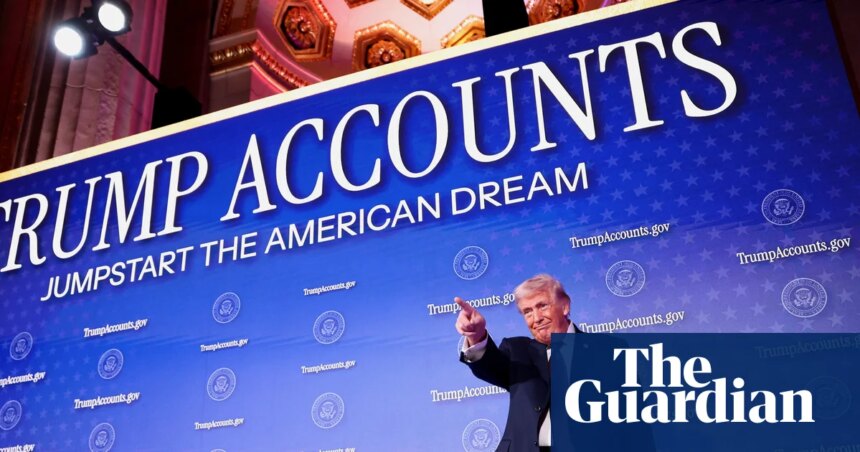
Accounts known as Trump accounts, named after the former U.S. president and sanctioned by congressional Republicans, are set to launch this Saturday. This initiative aims to provide American parents with a novel savings avenue for their children, allowing investments in funds managed by prominent Wall Street firms.
These accounts are designated for children born between January 2025 and December 2028, coinciding with nearly the entirety of Donald Trump’s second term. Each account will receive an initial $1,000 contribution from the government. Parents, guardians, and other supporters such as friends and employers can add up to $5,000 annually to these accounts. To establish an account, parents must complete IRS form 4547, an homage to Trump’s unique presidential history, having served as both the 45th and 47th president.
The launch of these accounts comes at a pivotal moment as Republicans gear up for the midterm elections in November. The party is eager to showcase new initiatives to voters who have expressed concerns regarding the president’s economic management.
The accounts are the result of the One Big Beautiful Bill Act, the signature domestic policy measure of Trump’s second term, which was approved by congressional Republicans last year. Parents and guardians will have control of the accounts until the children reach 18 years old, at which point the young adults can utilize the saved funds for major purchases such as college tuition, home buying, or starting a business.
Financial contributions will be primarily invested in funds linked to major Wall Street indices. The U.S. Treasury Department recently announced that, by default, all deposits would be allocated to a fund managed by State Street, tracking the S&P 500 index. Additional options, including funds from BlackRock and Vanguard, are expected to be available in the future.
Earlier this year, the Treasury also revealed plans for an app to manage these accounts, developed in partnership with Bank of New York Mellon and Robinhood, a trading platform that gained popularity during the COVID-19 pandemic due to its accessibility for amateur investors.
The initiative has attracted support from notable billionaires, including Michael Dell, who, along with his wife, donated $6.25 billion to ensure that 25 million children under 10 from disadvantaged areas receive an extra $250 in their accounts. Hedge fund manager Ray Dalio and his wife similarly contributed to aid approximately 300,000 underprivileged children in Connecticut.
Republican lawmakers have labeled the legislation as the “Working Families Tax Cuts Act,” contending that families have enjoyed the benefits of lower tax rates extending indefinitely. However, recent polling reveals growing dissatisfaction among voters regarding the president’s economic performance. A PBS News/NPR/Marist survey conducted last month indicated that two-thirds of respondents disapproved of Trump’s handling of economic issues.