The Department of Government Efficiency (DOGE) officially concluded its operations on July 4, a date established in an executive order signed by former President Donald Trump and set for January 2025. As the news surfaced, speculation intensified that Bitcoin (BTC) could inherit the narrative of reform following the abrupt end of DOGE, particularly stoked by prominent figures in the tech industry, including Elon Musk and Michael Saylor.
Musk, who previously worked closely with DOGE, chose to celebrate Independence Day with a patriotic video montage instead of marking the program’s termination, subtly sidestepping any official farewell. In response, Saylor, the executive chairman of MicroStrategy, engaged with Musk on social media, utilizing a symbolic reference to Bitcoin in his reply.
The formation of DOGE was initially intended to be a short-term initiative, with an original termination date slated for July 4, 2026, coinciding with America’s 250th anniversary. However, the program’s downfall occurred much sooner than anticipated; it had disbanded as a centralized entity by November of the previous year, months before its scheduled conclusion. Following the collapse, its public savings tracker ceased operations at the start of 2026. According to DOGE’s claims, the program saved approximately $215 billion, amounting to about $1,335 per taxpayer, which represents just 3% of the U.S.’s annual $7 trillion federal budget. This figure pales in comparison to the $2 trillion Musk proposed at a conference in October 2024.
In a recent update, Office of Management and Budget Director Russ Vought informed lawmakers that no closure report for DOGE is planned, as reported by Politico. Musk, who departed his role in Washington in May 2025 after serving 130 days, consistently portrayed the cessation of DOGE as a strategic move rather than a failure.
The efficiency initiative’s influence appears to be branching out beyond D.C., with New York City Mayor Zohran Mamdani launching a municipal efficiency program inspired by DOGE’s framework.
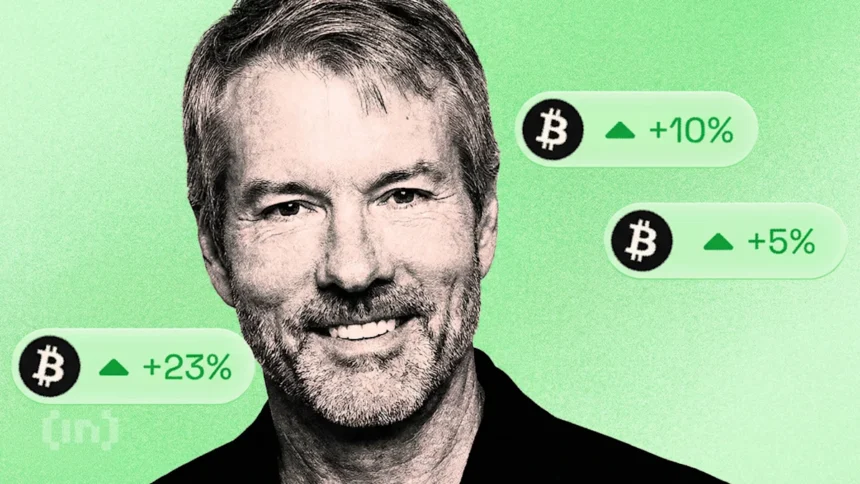
On the same day, Saylor’s response to Musk’s post was telling. By exchanging a letter with the Bitcoin logo in a message directed to Musk, Saylor signaled his ongoing interest in promoting Bitcoin’s potential. This was not the first occasion Saylor urged Musk towards greater Bitcoin engagement; he had famously encouraged Musk to diversify Tesla’s financial assets into Bitcoin back in December 2020. This resulted in Tesla purchasing $1.5 billion in Bitcoin two months later, although the company suspended Bitcoin payments in May 2021 due to energy-related concerns.
The exchange between Musk and Saylor was interpreted by traders as a symbolic transition from government reform to a focus on sound money, with several responses from the community suggesting Tesla should reinstate Bitcoin payments. As Bitcoin’s trading price hovers around $62,584—an increase of about 1% within the last 24 hours—the discourse surrounding the future of cryptocurrency continues to evolve.
For Saylor, this moment carries a bittersweet irony, particularly as MicroStrategy faces scrutiny over reports of a recent sale of 491 BTC and concerns surrounding a dividend policy described by JPMorgan as high-risk. The ongoing dialogue now pivots on whether innovation, epitomized by Bitcoin, can genuinely replace the reform initiatives exemplified by DOGE, or if Saylor’s and Musk’s holiday exchanges were simply fleeting messages rather than indicative of a deeper strategic pivot.