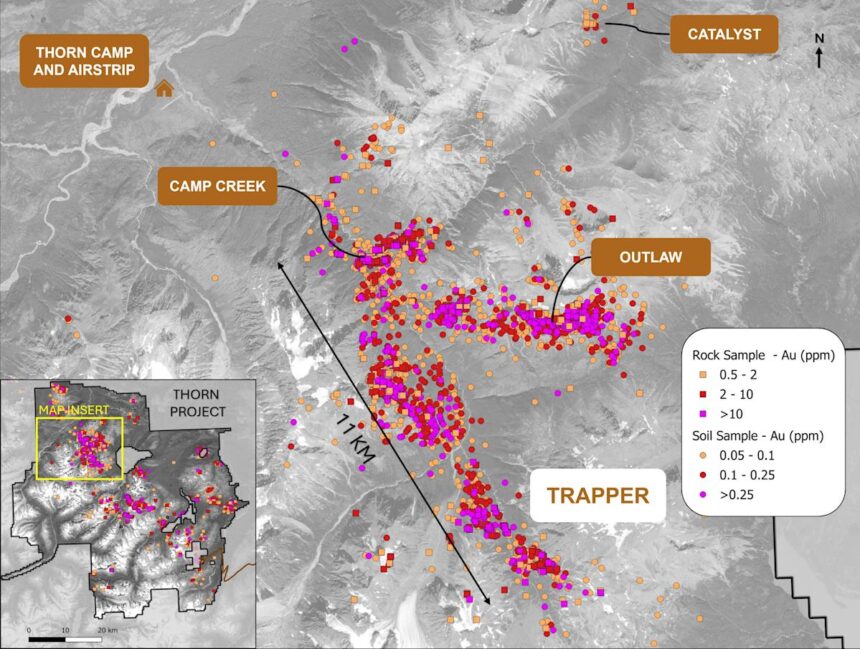
Brixton Metals Corporation, based in Vancouver, British Columbia, has announced initial drill results from its ongoing near-surface exploration program at the Trapper Gold Target. This marks a significant milestone as the latest findings include results from the first nine of a total of 27 holes drilled to date, amounting to a combined total of 5,392 meters. Alongside this, six additional holes have been completed at the Catalyst and Tempest copper-gold porphyry targets, although assay results from these holes are still pending.
The results from the Trapper site indicate promising extensions of gold and silver mineralization southeast of the main mineralized zone. One noteworthy drill hole, THN25-335, returned 29 meters at a grade of 1.75 grams per ton (g/t) of gold and 5.72 g/t of silver, starting from a depth of 72.5 meters. Another hole, THN25-329, revealed 1.0 meter grading 5.96 g/t of gold and 29.20 g/t of silver within a broader interval of 33 meters averaging 0.43 g/t of gold and 3.37 g/t of silver from a depth of 77 meters.
Chairman and CEO Gary R. Thompson stated, “Drilling at the Trapper Gold Target continues to show promise for expansion of the gold mineralization, notwithstanding that it has proven to be a structurally complex system with post-mineral movement. The target remains open for expansion in multiple directions.”
Drill holes THN25-327 through THN25-333 were primarily designed to test new mineralization zones that are parallel to the main Northwest-Southeast mineralized trend. Among these, hole THN25-335 stands out as it marks the first in a series of holes aimed at discovering the southeastern extension of the primary mineralized zone.
Initial interpretations suggest that the mineralization identified in THN25-335 is associated with a fine-grained feldspar porphyry intrusive phase, which may indicate a previously unrecognized style of mineralization at Trapper. This potential addition may complement the base metal vein system defining the core of the mineralized body. Follow-up drilling is planned to further evaluate the significance of this new mineralization style.
Despite some drill results showing relatively lower grades, narrower base metal-style veins are present and appear connected to intrusive phases similar to the main mineralized trend. For instance, THN25-329 yielded 33 meters averaging 0.43 g/t of gold and 3.37 g/t of silver, while THN25-330 returned 42.78 meters containing 0.13 g/t of gold and 1.64 g/t of silver.
The drilling program aims to explore shallow depths and assess the potential for new mineralization, with high-grade surface rock samples indicating favorable conditions. However, several drills, including THN25-327, THN25-328, THN25-332, and THN25-333, returned no significant results, while drill hole THN25-334 was abandoned due to a fault zone.
Brixton’s exploration activities at the Trapper Gold Target are part of a larger strategy to assess and expand its mineral resources effectively. The Trapper site has demonstrated a geochemical footprint of 4 km by 1.5 km, with a robust gold-in-soil signature that positively correlates with both zinc and lead. It represents an intermediate-sulphidation epithermal system, currently defined in volcanic and intrusive rock formations.
Brixton Metals is committed to high standards of quality control and assurance, with a rigorous protocol established for drill core sampling. The company employs industry-standard practices for sample collection and analysis, ensuring the integrity of its findings and maintaining compliance with the necessary regulations.
For additional information about Brixton Metals and their projects, interested parties can visit the company’s website or reach out to their investor relations team.