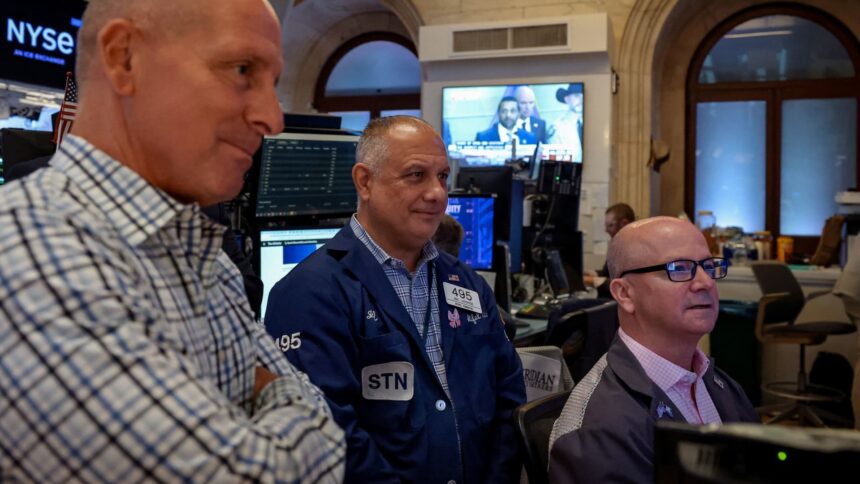
Investors seem unfazed by a cascade of concerning economic news, as Wall Street continues to reach new heights this week. Despite facing rising inflation driven by tariffs, signs of strain in the labor market, and geopolitical tensions, optimism around corporate profits and anticipated government assistance have buoyed market sentiment.
The Bureau of Labor Statistics released revised payroll figures indicating the economy created nearly one million fewer jobs than previously reported. This downturn coincided with a significant rise in layoffs last week, an uptick in inflation, and a notable dip in worker confidence, which has reached record lows. Additionally, the international backdrop remains turbulent, with ongoing conflicts in Ukraine and Gaza, shifting economic policies under President Donald Trump, and heightened political violence exemplified by the murder of conservative activist Charlie Kirk.
Nevertheless, the market is buoyed by expectations of forthcoming interest rate cuts by the Federal Reserve, alongside robust corporate earnings that show little impact from tariffs. Mark Luschini, chief investment officer at Janney Capital Management, commented on the prevailing market mood, emphasizing that investors are looking ahead optimistically, anticipating positive trends for the next six to nine months.
Experts stress that while monetary policy is a focus, the market’s current upswing is powered by several additional factors. These include deregulation efforts, retroactive depreciation write-offs, tax cuts from a proposed legislation dubbed the One Big Beautiful Bill, and the still-low unemployment rate, despite stagnant job creation. Luschini further noted that easing monetary policy signals relief is on the horizon.
Market indicators suggest that the Federal Open Market Committee is likely to decrease the benchmark federal funds rate by 25 basis points from 4.25% to 4.50% in its upcoming meeting. Traders anticipate further cuts in October and December, followed by additional reductions in 2026, a more aggressive outlook compared to previous guidance from FOMC members. This anticipated policy shift provides some reassurance that any economic weaknesses may be offset by policy support.
Mark Hackett, chief market strategist at Nationwide Financial, underscored investor confidence, stating that the market is increasingly viewing the mixed economic data as balanced by potential policy and fiscal support. He emphasized that slowing labor momentum does not necessarily signal a downturn in corporate earnings or economic growth, as supportive conditions could mitigate recent economic slowdowns.
Inflation continues to pose challenges, highlighted by data showing a rise in consumer prices despite a decline in producer prices. The consumer price index saw a 2.9% increase year-over-year in August, the highest since January, prompting concerns over pricing pressures in areas particularly affected by tariffs, such as groceries, clothing, and furniture.
On a brighter note for investors, the technology sector remains vibrant. Oracle recently surpassed earnings expectations, forecasting substantial demand for its cloud services, resulting in its largest single-day stock rally in 33 years, although the excitement subsided afterward. Market analyst Tom Lee of Fundstrat Global Advisors pointed out that leading tech firms, like Nvidia, are currently undervalued when compared to more traditional staples like Costco and Walmart. He argued that this finding underscores a broader undervaluation across artificial intelligence stocks.
Additionally, Ed Yardeni noted that forward earnings estimates have reached record highs for 16 consecutive weeks. Wells Fargo also projected positive developments, asserting that investments in AI and a more accommodating Fed policy should sustain market gains, setting a target of 6,650 for the S&P 500 by year-end and predicting a rise to 7,200 by 2026.
Ohsung Kwon, Wells Fargo’s chief equity analyst, confirmed a bullish outlook on equities, acknowledging market fluctuations but asserting that as long as AI investment remains stable, the prevailing bull market will continue.