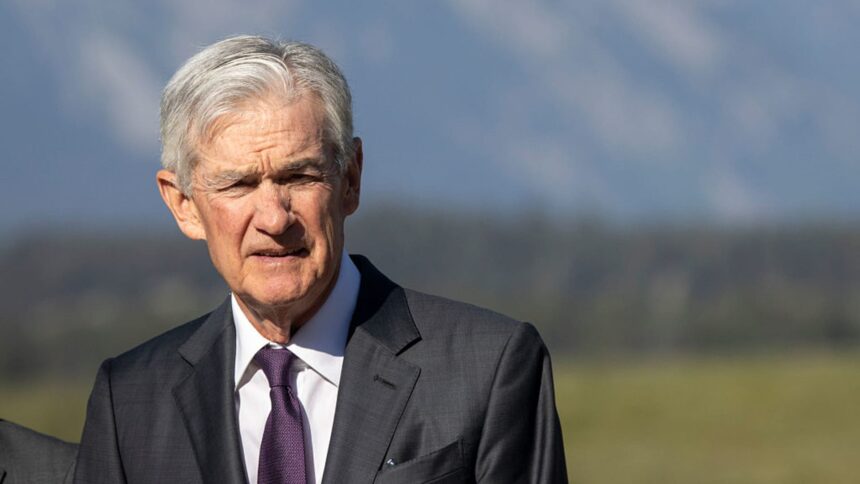
Federal Reserve Chair Jerome Powell’s upcoming remarks on the path of monetary easing are anticipated to play a crucial role in guiding a stock market that has been keenly fixated on potential interest rate cuts. The pivotal Federal Reserve meeting scheduled for September 16-17 has generated substantial speculation among investors, who are largely convinced that the central bank will announce its first rate cut since December. Many are even optimistic, hoping for a significant half-percentage-point reduction.
Adding to the intrigue, the latest Summary of Economic Projections is also expected to offer crucial insights into the Fed’s monetary policy outlook. Historically, lower interest rates have acted as a catalyst for stock market growth, providing a boost to equities that have already been on an upward trajectory. However, growing concerns about the economy, particularly within the labor market, are becoming increasingly evident. These anxieties are manifesting in various segments of the financial markets, including rising bond yields and a surge in gold prices.
This past week observed notable shifts in the yield curve; the short end climbed while the long end dipped, raising concerns among investors that these developments could have downstream effects on equities. Mark Malek, investment chief at Siebert Financial, commented on this phenomenon, stating, “The whole yield curve is shifting down, but the curve is changing shape as well.” He noted that the movement in the yield curve might indicate underlying apprehensions regarding the economic outlook, particularly pointing to recent job numbers that could signal an impending economic slowdown.
Despite these strains in the labor market, the stock market continues to perform well. As of Friday, major stock indexes were poised to close the week on a positive note, with the Dow Jones Industrial Average rising roughly 1%. The S&P 500 has remained close to all-time highs, experiencing a 1.6% increase, while the tech-heavy Nasdaq Composite saw a 2% gain.
Many investors still harbor confidence that advancements in artificial intelligence (AI) will sustain the rally in equity markets, even amid economic headwinds. However, concerns linger over how long this optimism can last, especially considering the theoretical “crossover” point when economic weakness might dampen enthusiasm for AI investments. Malek expressed this sentiment, insisting that while AI represents a significant growth opportunity, it is uncertain how much longer it can defy the overarching economic trends.
The economic environment remains fraught with uncertainty. The latest consumer price index readings were closely aligned with expectations, providing some reassurance to investors. However, deeper analysis revealed rising price pressures across a variety of categories, including apparel, vehicle parts, and groceries. These developments spell concern for the broader market. Compounding these worries, the benchmark 10-year U.S. Treasury yield recently fell to 4.0%, coinciding with rising jobless claims that underscore a cooling labor market.
Gold prices are also approaching an all-time high, surpassing $3,600, as the asset continues its upward trajectory following a three-year bull run. Market sentiments reflect growing anxiety, with Malek observing that “the typical hallmarks of anxiety are all there.”
In the week ahead, a series of economic indicators are slated for release, including the Empire State Index and various metrics related to imports, exports, and housing starts. As investors await crucial data points and the Fed’s decision, the economic landscape remains complex and turbulent.