The emergence of artificial intelligence (AI) has raised significant concerns about its potential impact on the workforce, particularly within white-collar professions. Anthropic, a leading AI company established in 2026, has recently released a study discussing the capabilities of AI tools and the extent to which they might render various jobs obsolete.
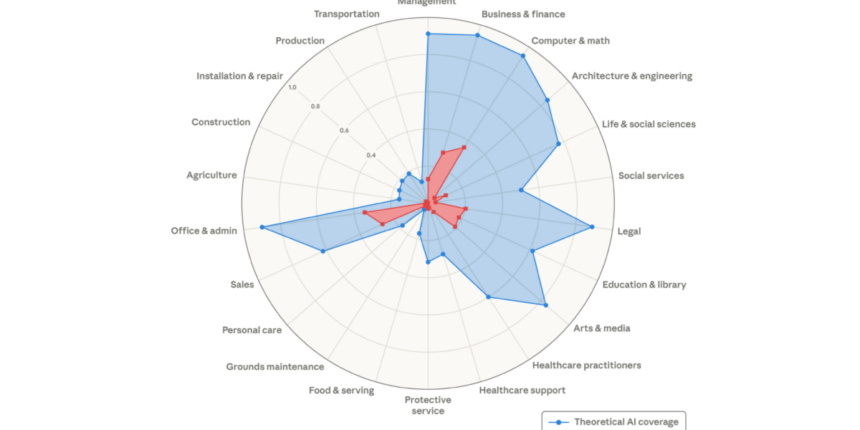
In their report, titled “Labor market impacts of AI: A new measure and early evidence,” researchers Maxim Massenkoff and Peter McCrory reveal a stark contrast between AI’s theoretical capabilities and actual adoption rates in professional environments. Their findings indicate that while AI can theoretically perform a wide range of tasks in sectors such as business, finance, management, and office administration, the real-world usage of these technologies remains considerably limited.
Business leaders have been warned for some time about the potential upheaval AI could cause within the job market. Prominent figures, including Anthropic CEO Dario Amodei, have noted that AI could disrupt as much as half of entry-level white-collar jobs, while Microsoft’s AI chief, Mustafa Suleyman, predicts that significant portions of professional work might be replaced within the next 18 months.
The report identifies a concept called “observed exposure,” measuring actual AI capability against real-world usage data. This new metric suggests that the current use of AI in workplaces is only a fraction of what is theoretically possible. Notably, it highlights that workers most at risk include those who are older, well-educated, and highly paid, contrary to the traditional view of blue-collar jobs being the most threatened. Fields such as law, finance, and software development are among the most exposed.
Despite the long-term implications for these occupations, most professionals in the identified sectors have yet to experience immediate job displacement. For instance, while AI can theoretically automate tasks like the authorization of drug refills in healthcare, researchers have not observed its actual use in this area. The study indicates that for computer and math workers, AI can handle 94% of tasks in theory but only executes around 33% of these in practice.
The findings, portrayed through graphs contrasting “actual usage” against “theoretical capability,” predict a future where the gap narrows as AI technology continues to advance. Currently, 30% of workers in sectors requiring physical presence, such as cooking and mechanics, remain untouched by AI.
The report raises alarms about potential job losses akin to those experienced during the 2007–2009 financial crisis. Should the unemployment rate double among top AI-exposed occupations, a pattern resembling this historical economic downturn could emerge.
On a broader scale, the U.S. Bureau of Labor Statistics recently reported a decrease in jobs, with employers shedding 92,000 positions in February alone, causing the unemployment rate to rise to 4.4%. Major firms, like Block, have attributed layoffs to AI, with CEO Jack Dorsey indicating that innovations in intelligence tools are reshaping corporate operations.
For younger workers, however, the issue seems less about layoffs and more about a slowdown in hiring within AI-exposed fields. Research indicates a 14% drop in the job finding rate for these roles since the rise of AI technologies like ChatGPT, although this decline is only slightly statistically significant. Encouragingly, firms like Citadel Securities note that hiring for software engineers has increased, which challenges the narrative of a widespread employment crisis.
In summary, as AI continues to evolve and penetrate various sectors, the implications for the workforce are profound, suggesting both potential opportunities and considerable risks for workers, especially in white-collar jobs. The ongoing adjustments in hiring practices and job dynamics will need careful monitoring to understand the full impact of AI on the labor market.