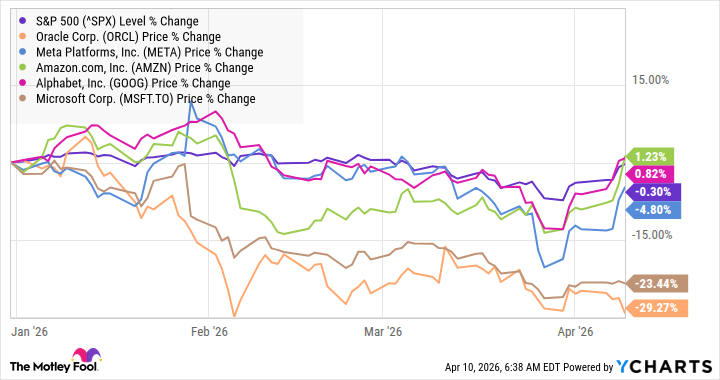
As the market continues to delve into the realm of artificial intelligence (AI), there is growing concern about the potential for an AI bubble, particularly among the leading hyperscalers. Analysts are closely observing the share price performance of major players in the industry, especially Oracle and Alphabet, as indicators of market sentiment and investor confidence.
The situation is further complicated by the performance of these tech giants in 2026, with Oracle and Microsoft exhibiting notable underperformance. This downturn is primarily attributed to their substantial exposure to OpenAI, the entity behind the burgeoning AI landscape. Oracle recently entered into a massive $300 billion agreement with OpenAI, aimed at building AI data center infrastructure essential for the latter’s operations. Similarly, Microsoft reported that a significant 45% of its remaining performance obligations stem from its involvement with OpenAI.
Investor anxiety around these companies is echoed in the bond markets, specifically through an analysis of credit default swaps (CDSes), which serve as insurance against the risk of bond defaults. This measure provides insight into how the debt markets perceive the stability of these corporations. Over the past year, CDS pricing data reveals that while investors are not particularly concerned about defaults from Alphabet and Microsoft, Oracle’s perceived risk has risen significantly.
Interestingly, despite the apprehension surrounding Oracle’s financial viability, there remains a strong appetite for funding AI companies. A recent funding round for OpenAI—backed by major players including Amazon, Nvidia, and Microsoft—successfully raised $122 billion, giving the company a staggering post-money valuation of $852 billion. This influx of capital underscores investor confidence in AI’s potential growth. However, apprehensions linger regarding the costs associated with developing the necessary infrastructure.
Given the contrasting situations of these companies, analysts suggest that cautious investors might prefer to focus on well-established firms like Alphabet, which are not only financially robust but also take the lead in developing advanced AI models. Despite Alphabet’s strong position in the market, it is worth noting that recent recommendations from analysts suggest there are currently other stocks offering potentially more lucrative investment opportunities.
For investors looking to navigate this complex landscape, understanding the dynamics of AI hyperscalers and their relationships with entities like OpenAI will be crucial. The continued evolution of the AI sector poses both significant opportunities and risks, highlighting the importance of strategic investment choices in an ever-changing market.