A significant outage of Amazon Web Services (AWS) on Monday severely disrupted numerous cryptocurrency platforms, underscoring the reliance of an industry that professes decentralization on centralized infrastructure. Users across platforms like MetaMask, Coinbase, Base, and OpenSea experienced widespread malfunctions that lasted for several hours.
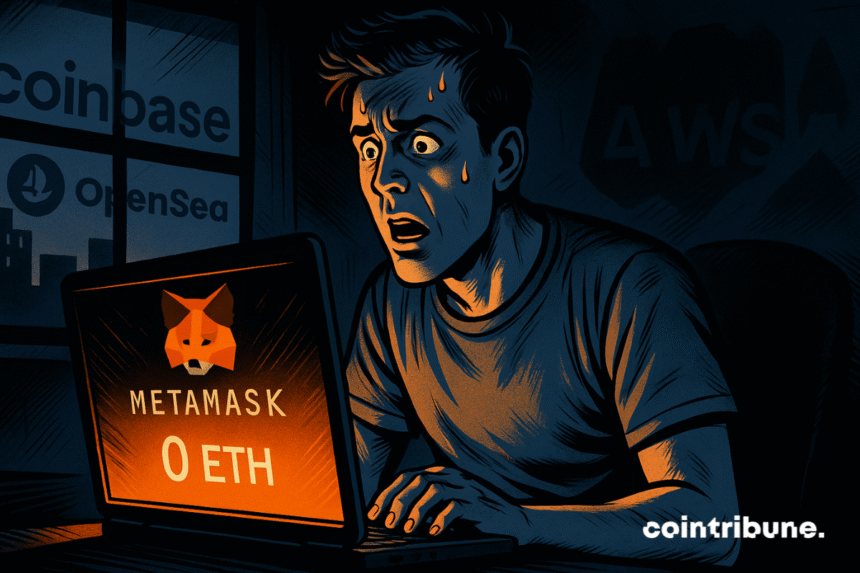
The disruption commenced early Monday when AWS, a key provider of cloud services, went down. This incident particularly impacted MetaMask, one of the world’s most popular decentralized wallets. Users logged in only to find their balances displaying zero, a situation caused by issues with Infura, a crucial service that links decentralized applications to various blockchains. Infura’s dependency on AWS for real-time data led to users being cut off from networks including Ethereum, Base, and Polygon.
Coinbase, the parent company of the Base network engineered to facilitate faster and more scalable transactions, also faced challenges. Following the outage, users encountered significant latencies, synchronization errors, and inconsistencies in block production, raising concerns about the reliability of a network intended to exemplify the future of Web3.
While Coinbase struggled to restore its services, many users remained unable to trade or transfer assets long after the initial disruption began. Interestingly, Robinhood, another platform impacted by the same outage, managed to resume normal operations, further highlighting the difficulties facing Coinbase during this crisis.
OpenSea, the leading NFT marketplace, also reported considerable challenges. Despite the site appearing functional, its CTO acknowledged that disruptions persisted due to problems with upstream providers. This resulted in increased error rates and a markedly poor user experience.
The AWS outage has brought to light a pressing question: how can an industry built on principles of decentralization be so heavily dependent on a single cloud service provider? The incident revealed a vulnerability integral to the crypto ecosystem, further compounded by the geographical concentration of AWS servers. Notably, users on the US East Coast experienced the most significant disruptions.
However, amidst the challenges, there was a silver lining: a drastic decrease in Ethereum transaction fees. As overall activity plummeted, gas fees fell to below 0.1 gwei, which is historically low and less than a tenth of the previous day’s rate.
Ultimately, this outage serves as a stark reminder of the journey that lies ahead for the cryptocurrency sector. While promoting ideals of resilience and independence, the industry’s reliance on centralized giants like Amazon exposes it to systemic vulnerabilities. Observers have pointed out this contradiction, noting the inherent irony of a decentralized sector being so reliant on centralized infrastructure.