Recent analysis of bitcoin (BTC) futures trading data from the past five years reveals significant insights into the cryptocurrency’s historical price behavior and support levels. By evaluating the frequency of bitcoin’s trading days within specific price ranges, traders can identify areas where market participants have built substantial positions, which often lead to stronger support.
Data compiled by Investing.com indicates distinct variances in the amount of time bitcoin has spent in various price bands. Notably, aside from its fleeting ascent above $120,000, bitcoin has shown minimal presence in the $70,000 to $79,999 range, with just 28 trading days recorded. Similarly, the cryptocurrency spent only 49 days in the $80,000 to $89,999 bracket. In stark contrast, the lower price zones, particularly between $30,000 to $39,999 and $40,000 to $49,999, witnessed nearly 200 trading days, signifying extensive testing and consolidation in those levels.
As of December, bitcoin has largely traded within the $80,000-$90,000 range, following a notable correction from its October all-time high. This recent price action has returned bitcoin to a territory where it has historically spent little time, especially when considering the prior year during which it consistently occupied the $50,000 to $70,000 range. The uneven distribution of trading days across these price bands implies that support in the $80,000s—and even more so between $70,000 and $79,999—is likely weaker compared to the lower ranges.
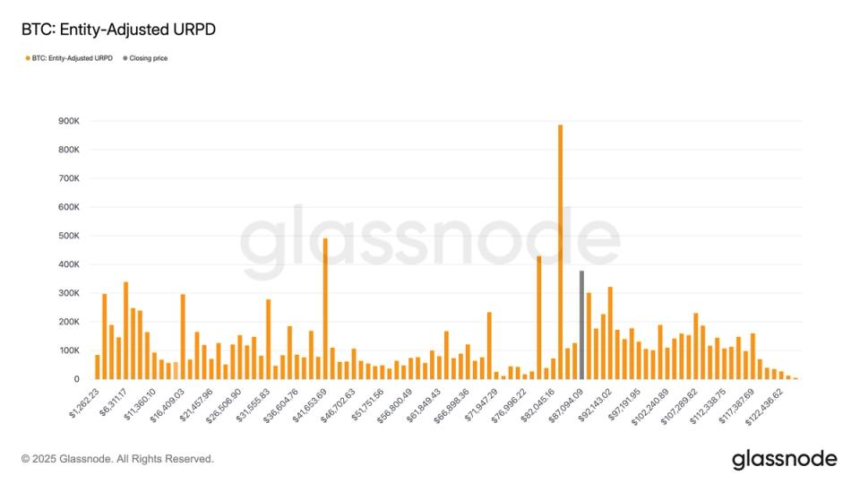
Further validation comes from Glassnode’s analysis, which employs the UTXO Realized Price Distribution (URPD) model. This framework tracks the last active movement of bitcoin supply, providing insights into how entities hold their assets. The URPD analysis reveals a notable absence of bitcoin supply concentrated within the $70,000 to $80,000 range, further corroborating the findings from the futures data. Together, these datasets suggest that should the cryptocurrency enter another corrective phase, the $70,000 to $80,000 area could be a critical zone for consolidation to solidify stronger support levels.
This deep dive into bitcoin’s trading dynamics offers a clearer understanding of potential market movements and areas where strategic positioning may develop. Investors and traders are urged to consider these patterns as they navigate the complex landscape of cryptocurrency trading.