The rapid rise of artificial intelligence (AI) has significantly influenced stock market trends, particularly since the launch of ChatGPT in November 2022. According to a JP Morgan Asset Management report, AI-centric stocks have contributed an impressive 75% to the S&P 500’s returns during this period. Major technology firms including Microsoft, Amazon, Alphabet, and Meta Platforms are heavily investing in AI infrastructure, pouring hundreds of billions into advanced chips and extensive data centers in anticipation of a future driven by AI innovation.
However, skepticism has begun to creep into the market regarding the AI narrative. An MIT study published in August 2025 indicated a troubling trend, revealing that a staggering 95% of generative AI projects across businesses failed to yield measurable returns on investment. This has raised flags among investors, suggesting that companies may struggle to translate their AI investments into profitability or efficiency gains. As a result, concerns have emerged that the current AI boom could potentially bubble, leading many to reconsider their investment strategies.
In this climate of uncertainty, Apple stands out as a tech stock that may be insulated from the volatile AI narrative. While stellar companies in the AI space have significantly invested in AI, Apple has adopted a more cautious approach. The tech giant is not primarily an AI company and does not rely on the speculative benefits of AI for its financial viability. Earlier criticisms suggested that Apple was lagging in its AI strategy, but its measured pace may actually benefit shareholders in the long run. Rather than engaging in a costly race to dominate AI, Apple has remained focused on strengthening its core business—selling phones and laptops.
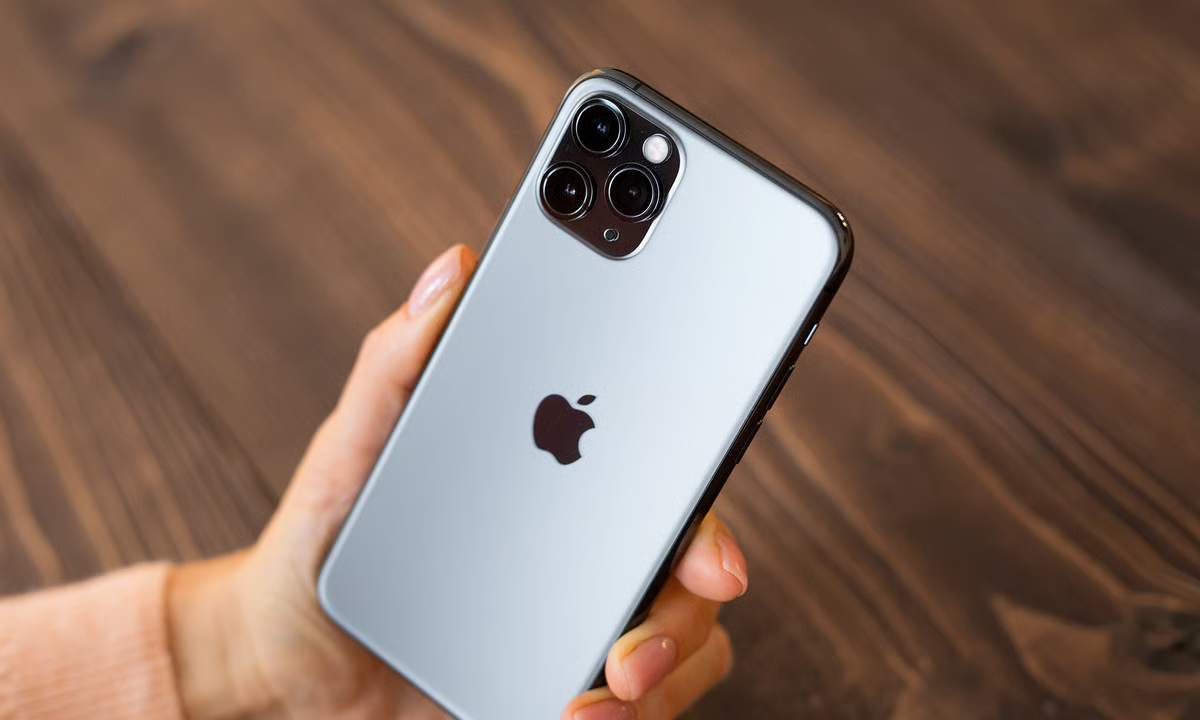
In terms of performance, Apple has shown remarkable growth, with its stock surging approximately 33% over the past six months, outpacing the S&P 500’s gain of 11%. The company’s stock has also outperformed other AI-centric players, including Nvidia and Oracle. The recent launch of the iPhone 17 in September 2025 generated exceptional demand, with Apple projected to ship 247.4 million iPhones this year—a 6.1% increase compared to the previous year.
In its fiscal year 2025, Apple reported record revenue of $416 billion and a fourth-quarter revenue of $102.5 billion, marking an 8% year-over-year rise. Notably, iPhone revenue grew by 6% from the previous year. Furthermore, Apple’s services segment continues to thrive, increasing by 15% year-over-year and experiencing a gross margin of approximately 75%, significantly higher than the 36% margin on physical products. In fact, sales from services in Q3 of fiscal year 2025 surpassed those of all non-iPhone products combined, highlighting its importance as a profit driver.
Looking ahead, optimism remains strong for Apple as it anticipates revenue growth of 10% to 12% in the first quarter of 2026, fueled by expected double-digit growth in iPhone sales during the holiday season. Analysts have raised their earnings per share (EPS) estimates for this quarter to $2.67, up from $1.77 in Q4 of fiscal 2025.
Although Apple’s current price-to-earnings (P/E) ratio of 34 suggests it is not a bargain compared to previous years, it could become more attractive if investors pull away from high-priced AI stocks amidst growing skepticism. As it stands, unless a groundbreaking device emerges to challenge the iPhone, Apple appears well-positioned to maintain strong profitability in the years to come. This resilience may make Apple an appealing investment option as 2026 unfolds, even amid ongoing concerns regarding the potential AI bubble.