Major Asian stock markets were largely closed midweek as Tokyo and Seoul observed the year-end and New Year’s holidays. However, trading continued in some markets, with mixed results reported across various bourses.
In China, the Hang Seng Index decreased by 0.5%, settling at 25,715.16, while the Shanghai Composite Index slightly improved, rising less than 0.1% to 3,966.39. Meanwhile, Taiwan’s Taiex saw a more positive trend, climbing 0.7% to reach 28,893.59. On the other hand, Australia’s S&P/ASX 200 index dipped marginally by 0.1%, closing at 8,706.40.
Tokyo is set to remain closed for trading until Monday, while South Korea will also halt operations on Thursday. Wall Street, despite a thin trading volume earlier in the week, remained active on Wednesday but will observe a closure on Thursday.
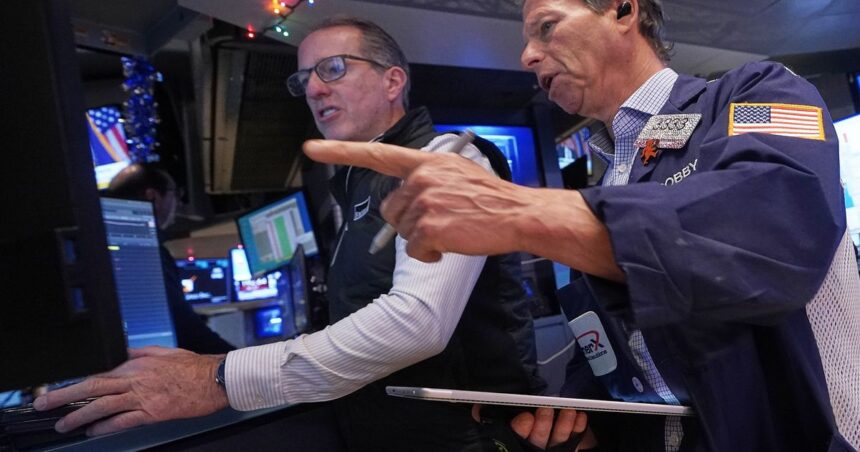
The S&P 500 index recorded a slight decline, dropping 9.50 points or 0.1% to end at 6,894.24. Despite a series of minor losses over the last few days, the index is on pace for an annual gain exceeding 17%. The Dow Jones Industrial Average fell by 94.87 points to 48,367.06, and the Nasdaq composite lost 55.27 points, resulting in a final score of 23,419.08.
Technology stocks have continued to exert significant influence on market performance, particularly companies involved in artificial intelligence innovations. Nvidia saw a decrease of 0.4%, while Apple’s stock fell by 0.2%, both affecting the broader market sentiment. Conversely, Meta Platforms, the parent company of Facebook, experienced a rise of 1.1%, following its acquisition of AI startup Manus as part of a broader strategy to enhance its AI capabilities.
A more substantial focal point was observed in the commodities markets, where gold prices surged by 1.4%, reaching $4,386.30 per ounce. Silver saw a notable gain of 10.9% as well. The previous decline in prices for both metals was attributed to the Chicago Mercantile Exchange’s requirement for traders to increase cash reserves for precious metal transactions. Both gold and silver have witnessed a pricing surge throughout 2025, influenced by economic uncertainties and supply challenges.
Copper prices also enjoyed a rise of 4.4%, marking a more than 40% increase for the year, driven by robust demand. This base metal is critical for global energy infrastructure, with anticipated growth in demand tied closely to advancing artificial intelligence technologies, which are putting additional pressure on data centers and the energy grid.
In the energy sector, U.S. crude oil slipped by 7 cents to $57.88 per barrel, while the price of Brent crude fell similarly to $61.26 per barrel.
The bond market saw mixed outcomes, with the yield on the 10-year Treasury climbing slightly to 4.12% from 4.11% late Monday, whereas the yield on the two-year Treasury remained stable at 3.45%. Overall, Treasury yields have decreased notably throughout the year, partially driven by market expectations regarding a potential shift in interest rate policy from the Federal Reserve, which has implemented three interest rate cuts in late 2025, the latest occurring in December.
The Federal Reserve is navigating a complex economic landscape characterized by weakening consumer confidence amid ongoing inflationary pressures. A protracted U.S.-led trade war could further exacerbate inflation, complicating the Fed’s ability to stimulate growth without worsening inflation, which remains above the targeted 2%.
The central bank’s cautious stance was mirrored in the minutes from its December meeting, highlighting internal divisions as it seeks to address the evolving economic threats. Market predictions suggest that the Fed will likely hold interest rates steady during its January meeting.
In currency markets, the U.S. dollar gained marginally against the Japanese yen, rising to 156.39 yen from 156.36. The euro remained relatively unchanged, trading at approximately $1.1745, compared to $1.1744 previously.