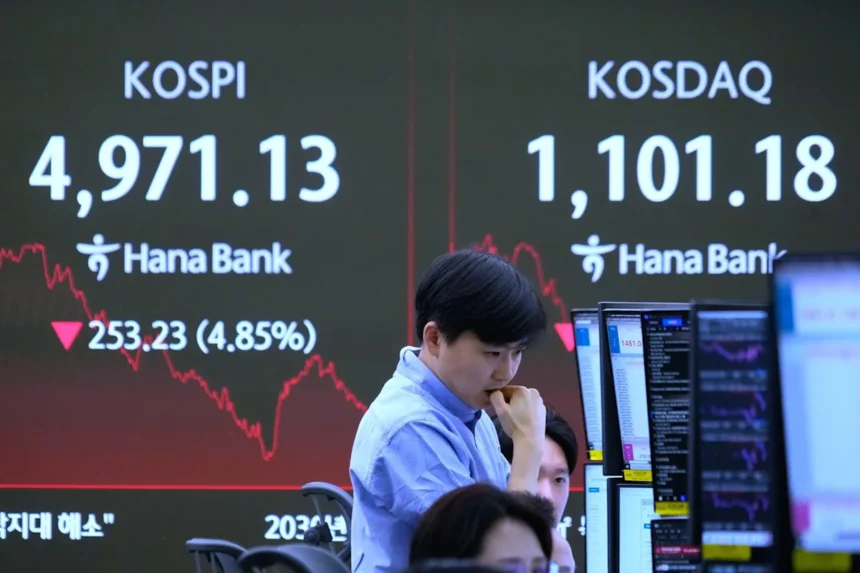
Shares across Asia experienced a notable decline on Thursday, driven by substantial selling pressure on technology stocks, while the cryptocurrency market also faced a setback, with bitcoin plunging as much as 8%. This heightened volatility in tech equities contributed to a nearly 4% drop in South Korea’s Kospi index, with U.S. stock futures also reflecting this downward trend. Oil prices fell, recording a drop of over $1 per barrel.
At the start of trading, bitcoin was priced around $71,000 but tumbled 7% to approximately $69,000 during the day, marking its lowest point since November 2024, as reported by CoinDesk.
In Asian markets, Tokyo’s Nikkei 225 index decreased by 0.9%, closing at 53,818.04. South Korea’s Kospi faced a significant drop of 3.9%, finishing at 5,163.57. Major players in South Korea’s technology sector felt the brunt of the sell-off, with shares of Samsung Electronics declining by 5.9% and chip manufacturer SK Hynix plummeting 6.7%.
Chinese markets saw similar retreats, with Hong Kong’s Hang Seng index slipping 0.3% to 26,761.00, while the Shanghai Composite index lost 0.6%, settling at 4,079.68. In Australia, the S&P/ASX 200 fell by 0.4% to close at 8,889.20, and Taiwan’s Taiex experienced a loss of 1.5%.
The U.S. markets mirrored this trend on Wednesday, as the S&P 500 fell by 0.5% for its fifth modest decline in six days, closing at 6,882.72. The Dow Jones Industrial Average managed a slight gain of 0.5%, reaching 49,501.30, whereas the Nasdaq composite saw a significant drop of 1.5%, ending at 22,904.58. Despite more than twice as many stocks rising within the S&P 500 compared to those that fell, declining tech stocks continued to weigh heavily on the index.
Notably, Advanced Micro Devices (AMD) plummeted by 17.3%, even though the chipmaker reported better-than-expected profits for the last quarter. While AMD’s revenue forecast for the start of 2026 exceeded analysts’ expectations, investors appeared dissatisfied, especially after the stock had doubled in value over the past year. The broader tech sector has faced increased scrutiny as many companies that once surged are now grappling with the threat of competition from firms leveraging artificial intelligence technologies.
Uber Technologies did not fare well either, with shares dropping by 5.1% after the ride-hailing giant reported quarterly results that fell short of projections, accompanied by a conservative profit forecast for the upcoming quarter and the announcement of a new chief financial officer.
Despite the widespread downturn in tech stocks, some companies did report gains. Notably, Super Micro Computer’s shares rose by 13.8% after the firm delivered stronger-than-expected profits for the latest quarter, indicating a robust demand for its AI servers and equipment.
In other financial markets, Walmart saw a minor increase of 0.2% after achieving a market valuation exceeding $1 trillion, joining the ranks of elite companies alongside tech giants like Nvidia and Apple.
Meanwhile, in the commodities market, U.S. benchmark crude oil prices dropped by $1.37 to settle at $63.77 per barrel, and Brent crude fell $1.47 to reach $67.99 per barrel. Precious metals, after earlier surges driven by investor flight to safety, experienced volatility again, with gold prices falling 0.3% and silver dropping by 7%. Critics have suggested that the rapid rise in precious metal prices was unsustainable and due for a correction.
The U.S. dollar strengthened against the Japanese yen, increasing to 157.00 from 156.80, while the euro fell slightly to $1.1790 from $1.1804.