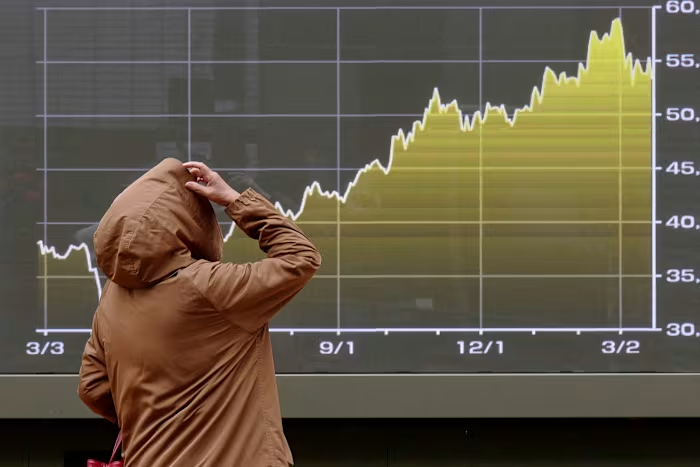
Asian markets experienced a downturn in morning trading on Monday, primarily influenced by rising oil prices and escalating tensions following comments from U.S. President Donald Trump regarding Iran. The Japanese Nikkei 225 index fell by 3.3%, landing at 51,638.85. Taiwan’s Taiex dropped 2.6% to 32,663.07, while the S&P/ASX 200 in Australia decreased by 0.7% to 8,366.20. South Korea’s Kospi saw a significant plunge of 5.1%, closing at 5,485.50. In Hong Kong, the Hang Seng index slipped 3.1% to 24,497.27, and the Shanghai Composite index fell by 2.1%, settling at 3,872.84.
Over the weekend, President Trump issued a stark warning about Iran, stating that the U.S. would “obliterate” Iran’s power plants unless it allows full access to the Strait of Hormuz within 48 hours. This ultimatum triggered a strong response from Tehran, which threatened to retaliate against U.S. and Israeli energy and infrastructure assets in the region. Analyst Ng Jing Wen from Mizuho Bank in Singapore commented, “Trump’s ultimatum and Iran’s retaliatory warnings point to a widening conflict that keeps energy disruption and market volatility elevated with no clear off-ramp in sight.”
The escalating conflict and rising oil prices have dampened expectations for an imminent interest rate cut by the Federal Reserve, which traders previously speculated. Before these renewed tensions, many market participants anticipated at least two rate cuts in 2026. Central banks in Europe, Japan, and the United Kingdom also kept their rates steady recently.
On Wall Street, the S&P 500 closed down 1.5% on Friday, marking its fourth consecutive week of losses, the longest such streak in a year. The Dow Jones Industrial Average dropped by 443 points, or 1%, and the Nasdaq composite fell by 2%, with approximately 75% of S&P 500 stocks declining. The Russell 2000 index, tracking smaller companies, led the losses with a significant 2.3% decline.
In the energy sector, U.S. benchmark crude oil prices rose by 31 cents, reaching $98.54 a barrel, while Brent crude fell by 27 cents to $111.92 a barrel. This marked a dramatic fluctuation for Brent, which surged from around $70 per barrel before the conflict reached its current intensity, peaking at nearly $119.50.
In finance, the bond market reflected rising tensions as well. The yield on the 10-year Treasury increased sharply to 4.38% on Friday, up from 4.25% the previous day and significantly higher than the 3.97% record before the conflict began. The two-year Treasury yield, which typically correlates with the Fed’s interest rate expectations, rose to 3.88%.
In currency exchanges, the U.S. dollar strengthened against the Japanese yen, climbing to 159.55 from 159.22. The euro was priced at $1.1545, a decrease from $1.1571.