Asian markets experienced mostly positive movements on Thursday, fueled by gains in U.S. stocks, which hovered close to record highs, following the resolution of a prolonged government shutdown in the United States. President Donald Trump’s signing of a government funding bill ended the 43-day shutdown that had resulted in significant hardships for federal employees, disrupted travel plans, and caused increased demand at food banks across the nation.
U.S. futures indicated a further uptick with the government set to reopen, alleviating financial pressures amid delays in the release of various federal economic data. According to Stephen Innes from SPI Asset Management, the market response reflected a collective optimism about the government returning to operational status. “For markets, the only line that matters is simple: the lights are coming back on,” he noted.
In the Asian markets, Japan’s Nikkei 225 saw a slight increase, rising by 0.3% to close at 51,213.35. However, technology giant SoftBank Group faced challenges, with its shares declining by an additional 3.4%, following a 3.5% dip the day before after the announcement that it had divested from its stake in Nvidia, a notable computer chip manufacturer.
Hong Kong’s Hang Seng index climbed by 0.3%, ending at 27,009.65, while the Shanghai Composite index rose by 0.7% to reach 4,029.50, buoyed by optimistic movements in mainland stocks as investors awaited new lending updates from China. In Australia, the S&P ASX 200 fell by 0.5% to 8,753.40 for a third consecutive day—the decline attributed to strong employment figures, reflecting a decrease in unemployment from 4.5% in September to 4.3% in October, dampening expectations for imminent interest rate cuts.
South Korea’s Kospi index displayed volatility, managing to increase by 0.6% to 4,176.44 during afternoon trading sessions. In the same vein, Taiwan’s Taiex index added nearly 0.2%, and India’s BSE Sensex experienced a boost of 0.3%.
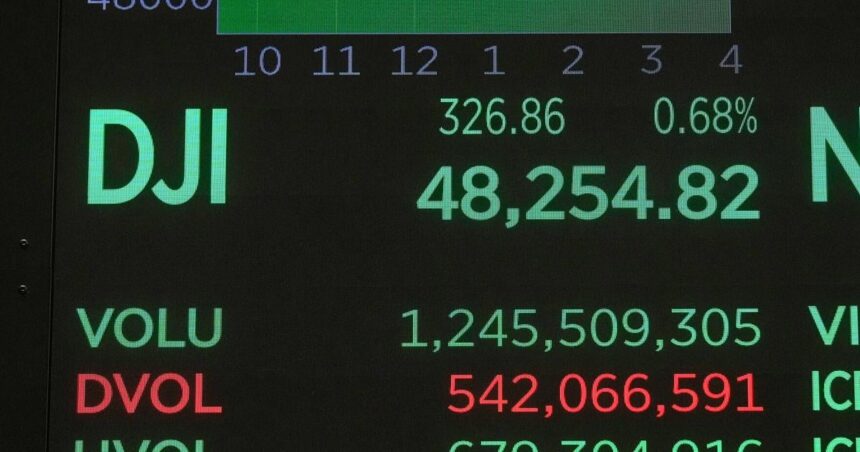
On the U.S. front, the previous day saw the S&P 500 inch up by 0.1%, nearing its all-time high, while the Dow Jones Industrial Average surged by 0.7%, achieving a new record for the second consecutive day, closing at 48,254.82. The Nasdaq composite, however, experienced a slight decline of 0.3%, finishing at 23,406.46.
The airline sector showed strong performance as optimism about a rebound in air travel post-shutdown rippled through the markets. In technology, Advanced Micro Devices led gains with a remarkable 9% rise, driven by CEO Lisa Su’s optimistic projection of over 35% annual compounded revenue growth over the next three to five years, attributing this to the accelerating momentum in artificial intelligence.
However, concerns about the sustainability of growth in stocks linked to AI surfaced, with critics drawing parallels to the dot-com bubble of 2000, which led to substantial market corrections. Nvidia, which had seen a 4.6% decline over the month, has had a volatile stock price, having more than doubled over the previous five years. Similarly, shares in Palantir Technologies experienced a drop of 3.6%.
The commodity sector displayed slight fluctuations as early Thursday indicated a minor downturn in U.S. benchmark crude oil, which fell by 9 cents to $58.40 per barrel, while Brent crude saw a drop of 8 cents to $62.37 per barrel. Currency movements showed the U.S. dollar gaining strength against the Japanese yen, rising to 154.93 yen from the previous 154.70, while the euro saw a slight dip to $1.1592 from $1.1594.