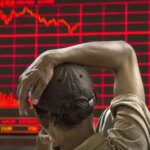
Asian stock markets displayed mixed results on Friday, influenced by a surge in U.S. tech shares which propelled benchmarks on Wall Street to new record highs. Despite the ongoing U.S. government shutdown due to a failure in bipartisan funding negotiations, markets appeared largely unfazed, with U.S. futures and oil prices on the rise.
The recent impasse saw President Donald Trump and congressional leaders distancing themselves from any immediate resolution, as Democrats insisted on retaining health care funding, raising concerns over potential price hikes affecting millions across the nation.
In Japan, the Nikkei 225 index experienced a notable gain of nearly 1.7%, closing at 45,691.32. This increase occurred even as unemployment data revealed a rise to 2.6% in August, the highest rate observed in over a year and surpassing the anticipated 2.4%. A significant boost came from Hitachi, which saw its shares soar by 9.2% following the announcement of a memorandum of understanding with OpenAI to supply cooling systems for data centers. The momentum in the tech sector was further supported by OpenAI’s partnerships with South Korean firms for a $500 billion AI infrastructure initiative called Stargate.
On the other hand, stock exchanges in China and South Korea were closed for holidays, leading to different trading conditions in the region. The Hang Seng index in Hong Kong dropped by nearly 0.9% to 27,052.32 as traders opted to take profits from previous gains, while Australia’s S&P/ASX 200 recorded a modest increase of over 0.3%, reaching 8,977.80. India’s BSE Sensex experienced a slight dip of 0.2%, whereas Taiwan’s Taiex rose by 1%.
In the U.S. markets, the S&P 500 edged up 0.1% to a closing record of 6,715.35, while the Dow Jones Industrial Average increased by 0.2% to 46,519.72, and the Nasdaq composite grew by 0.4% to finish at 22,844.05. However, the government shutdown has delayed the regular report on jobless claims, as well as a crucial monthly employment report, introducing uncertainty in the markets. Investors are particularly focused on the labor market, hoping it will provide enough information for the Federal Reserve to consider further cuts to interest rates without triggering a recession.
Historically, U.S. government shutdowns have not heavily impacted stock market performance, leading many to believe that the current situation may follow suit, albeit with Trump’s threats of large-scale federal layoffs complicating the outlook.
Corporate news has remained a pivotal factor driving trading activity. The excitement around AI advancements and the substantial financial investments in the sector have been major contributors to the U.S. stock market’s record streak. While tech stocks like Advanced Micro Devices and Broadcom experienced gains, there were growing concerns about the sustainability of the AI bubble, which could lead to future investor disappointments. Notably, Nvidia’s gains played a significant role in pushing the S&P upward.
By early Friday, benchmark U.S. crude oil prices rose by 36 cents, reaching $60.84 per barrel, while Brent crude climbed 36 cents to $64.47 per barrel. The U.S. dollar saw an increase against the Japanese yen, moving to 147.64 from 147.26, and the euro rose slightly to $1.1725 from $1.1717.