Asian markets displayed a mixed performance on Wednesday following the recent record highs set by the S&P 500 index. The fluctuations in the market coincided with a notable decline in the value of the U.S. dollar.
Investors are currently awaiting an announcement from the Federal Reserve regarding its future stance on interest rates, with indications suggesting that the rates will remain unchanged for the time being.
In South Korea, the benchmark index achieved a new record, driven by strong performances from technology companies, particularly SK Hynix, a major computer chip manufacturer, which saw its shares increase by 3%. The Kospi index rose 1.3% to reach 5,152.14.
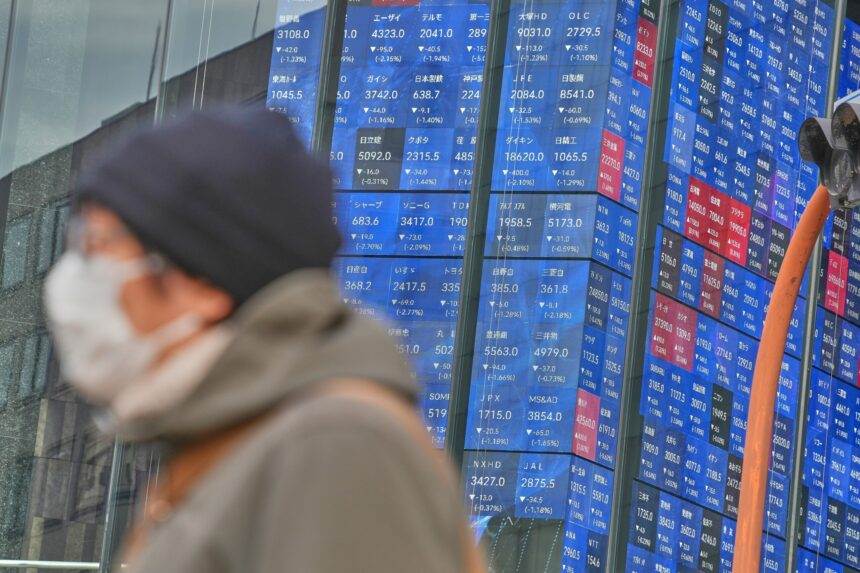
Conversely, Japan’s Nikkei 225 index faced a decline of 0.5%, settling at 53,055.58. The U.S. dollar showed a slight rebound against the yen, trading at 152.75, but is still down nearly 4% from the previous week’s high, when it hovered close to 160 yen. This drop has prompted increased pressure on larger exporters, with Toyota Motor Corp. experiencing a 3% decline alongside other leading manufacturers.
The euro also experienced a slight downturn, dropping to $1.1995 from $1.2041 earlier in the week, despite having risen significantly against the dollar previously.
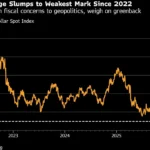
An index that tracks the strength of the U.S. dollar in comparison to several competitors has dipped to its lowest level since 2022. This decline has driven investment toward precious metals, with gold prices skyrocketing nearly 3% to surpass $5,200, and silver prices surging by 9%. Such movements are indicative of investors seeking refuge in safer assets during turbulent times.
In other developments across Asia, Hong Kong’s Hang Seng index climbed 2.4% to 27,782.59, while the Shanghai Composite increased by 0.5% to 4,160.01. Taiwan’s Taiex advanced by 1.1%, and India’s Sensex saw a rise of 0.5%.
In the U.S., stock movement was characterized by volatility on Tuesday due to mixed earnings reports from major companies like UnitedHealth and General Motors. Investors are keeping a close eye on upcoming earnings reports from influential corporations such as Meta Platforms, Microsoft, and Tesla later this week, and Apple on Thursday.
The S&P 500 managed to increase by 0.4%, reaching 6,978.60, thus surpassing its prior all-time high achieved a couple of weeks prior. On the other hand, the Dow Jones Industrial Average fell by 0.8% to 49,003.41, while the Nasdaq composite saw an uptick of 0.9% to settle at 23,817.10.
The weakening of the U.S. dollar has been tied to broader concerns regarding the country’s fiscal stability, particularly in light of threats made by former President Donald Trump regarding tariffs against European nations. Such threats have contributed to a phenomenon referred to as “Sell America,” where global investors hesitantly withdraw from U.S. markets.
Specific companies contributed positively to U.S. stock performance, with Corning witnessing a notable 15.6% increase following a $6 billion deal with Meta Platforms concerning optical fiber supplies for data centers. General Motors and HCA Healthcare also saw substantial gains, with rises of 8.7% and 7.1%, respectively, after both reported profits exceeding market expectations and outlined substantial stock buyback plans.
However, a recent report from the Conference Board indicated a decline in U.S. consumer confidence, a sentiment that fell to its lowest point since 2014, even lower than during the COVID-19 pandemic. Ongoing inflation remains a concern, consistently above the Fed’s 2% target, leading to speculation that the central bank may consider resuming interest rate cuts later this year.
As companies face increasing pressure to demonstrate robust profit growth following record highs in stock prices, analysts emphasize the need for earnings to align with elevated valuations in the market.
On a final note, early trading on Wednesday revealed an uptick in crude oil prices, with U.S. benchmark crude rising by 42 cents to $62.81 per barrel, and Brent crude increasing by 34 cents to $66.93 per barrel.