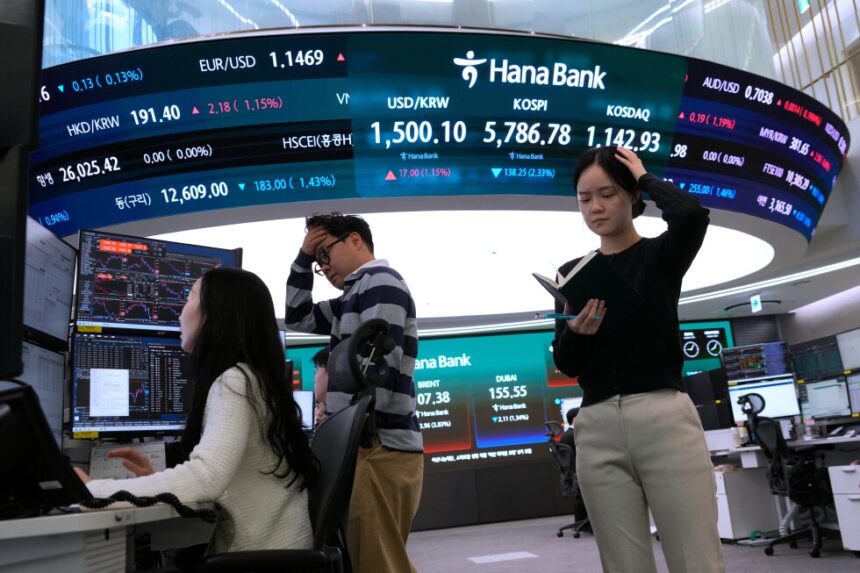
Shares across Asia experienced a sharp decline on Thursday, following a significant slump in U.S. stock markets amid rising oil prices, which climbed to over $113 per barrel. Investors reacted to disturbing reports indicating that inflation is likely to increase even further, a concern that has intensified with the ongoing conflict in Iran. The situation has caused oil and gas prices to soar, further complicating economic conditions.
U.S. futures showed minimal changes while Treasury yields increased, further bolstering the U.S. dollar, which has seen gains against other major currencies since the onset of the conflict. The spike in oil prices is primarily attributed to the disruptions in the Persian Gulf’s energy sector, exacerbated by Iran’s retaliatory actions against its Gulf Arab neighbors’ energy facilities following an Israeli attack on its key natural gas site. Recent attacks have ignited Qatari liquefied natural gas facilities and resulted in the shutdown of operations in the United Arab Emirates.
Should these disruptions persist, high oil and gas prices could unleash significant inflationary pressures on the global economy, analysts warn. As of early Thursday, Brent crude was trading at $113.52 a barrel, reflecting a 5.5% rise from the previous day, while U.S. benchmark crude rose by 1.1% to $96.45. Additionally, the Henry Hub natural gas futures contract increased by 3.3%.
In Asian exchanges, Japan’s Nikkei 225 dropped by 3.4% to 53,372.53 after the Bank of Japan decided to maintain its benchmark interest rate at 0.75%, citing concerns related to the Middle East tensions. In its monetary policy statement, the BOJ highlighted the need for vigilance in light of significant volatility in global financial markets and surging crude oil prices. Higher oil costs pose a significant challenge for Japan and other countries in the region, such as South Korea and Taiwan, that rely heavily on oil imports.
Other Asian markets similarly faced declines: the Kospi in Seoul fell 2.7% to 5,763.22; Hong Kong’s Hang Seng index decreased by 2% to 25,507.89, and the Shanghai Composite index dropped 1.6% to 3,996.44. Australia’s S&P/ASX 200 lost 1.7% to 8,497.80, while Taiwan’s Taiex fell by 1.9%. In India, the Sensex also experienced a downturn, dropping 2.3%.
The prevailing combination of increasing oil prices, rising U.S. yield rates, and a stronger dollar has created a challenging environment for Asian assets and currencies, according to Stephen Innes of SPI Asset Management. U.S. markets reflected this sentiment as well, with the S&P 500 falling 1.4% to 6,624.70, reversing earlier gains for the week. The Dow Jones Industrial Average declined by 1.6% to 46,225.15, while the Nasdaq composite dropped 1.5% to 22,152.42.
The Federal Reserve’s decision to keep its main interest rate steady, rather than implement cuts aimed at stimulating the economy, further fueled market anxiety. Fed Chair Jerome Powell expressed uncertainty about future oil prices and the time it would take for the effects of tariffs to materialize.
Adding to the economic woes, Wednesday’s report indicated that inflation pressures were mounting prior to the outbreak of the war, with U.S. wholesale inflation unexpectedly accelerating to 3.4% last month. In early trading on Thursday, the U.S. dollar weakened slightly against the Japanese yen, trading at 159.71 yen, while the euro appreciated to $1.1467 from $1.1453.