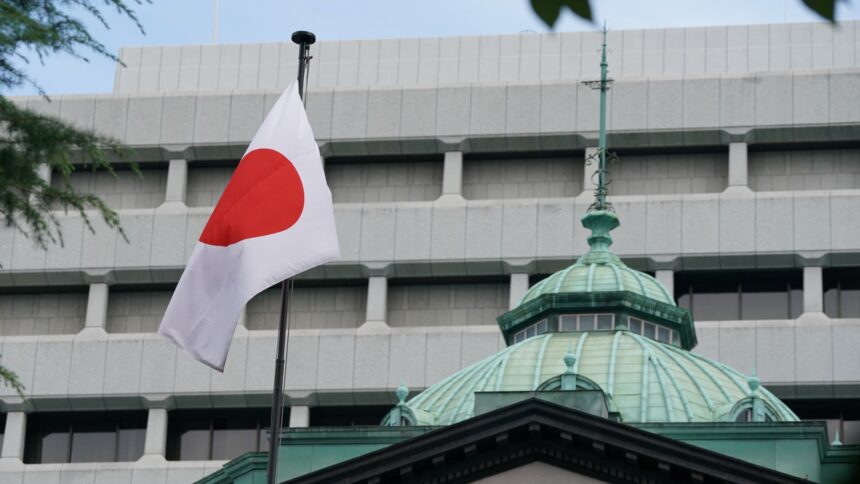
The Bank of Japan (BoJ) has opted to maintain its benchmark interest rate at 0.5% during its recent meeting, marking the first policy decision since Sanae Takaichi assumed the role of Prime Minister earlier this month. This decision aligns with the forecasts of economists surveyed by Reuters, despite Japan facing persistent inflation that has exceeded the central bank’s 2% target for over 41 consecutive months.
The results of the policy decision were notably divided, with a 7-2 vote among board members. Both Naoki Tamura and Hajime Takata advocated for a 25 basis point increase in the rate. Following the announcement, the financial markets reacted with relative calm; the yields on Japanese 10-year bonds remained mostly unchanged, while the yen depreciated by 0.2% to 153.03 against the dollar. Meanwhile, the Nikkei stock index observed a modest gain of 0.4%.
Krishna Bhimavarapu, an economist at State Street Investment Management, commented on the implications of the BoJ’s decision, noting a heightened likelihood of a rate hike within the next two scheduled meetings, contingent upon assessing the current volatility affecting global trade. Bhimavarapu suggested that while the central bank may still be inching toward tighter monetary policy, any significant shifts would likely occur gradually over the next year.
This policy decision takes place as U.S. Treasury Secretary Scott Bessent recently met with Satsuki Katayama, Japan’s new finance minister. Bessent reportedly critiqued Tokyo’s handling of the yen’s weakness and expressed views on Japan’s monetary policy direction. The U.S. Treasury Department subsequently emphasized the significance of robust monetary policy in stabilizing inflation expectations and mitigating excessive fluctuations in exchange rates.
Typically, an increase in interest rates can lead to a stronger currency by attracting foreign investment, whereas lower rates usually contribute to currency depreciation. The weak yen has stirred concerns internationally, particularly with previous comments from U.S. President Donald Trump, who accused Japan of systematically weakening its currency for competitive advantages in trade.
While Prime Minister Takaichi has previously championed lower interest rates, labeling BoJ rate hikes as “stupid,” there are indications that her stance may be evolving. Nevertheless, efforts to bolster the yen may conflict with her ambitions for substantial fiscal spending and a lenient monetary policy. Takaichi reiterated the importance of collaboration between the BoJ and the government to ensure effective communication of policy intentions.
Known for her advocacy of “Abenomics”—the economic framework attributed to the late Shinzo Abe, which emphasizes loose monetary policy, government spending, and structural reforms—Takaichi’s policies have already prompted marked fluctuations in the currency market. The recent “Takaichi trade” phenomenon has resulted in the Nikkei 225 index reaching new heights, coinciding with further depreciation of the yen beyond the 150 mark.
The backdrop to the BoJ’s decision includes concerns regarding Japan’s export performance. The country has witnessed a four-month contraction in exports prior to a minor rebound in September, although shipments to the United States continue to decline. This scenario further complicates the outlook for Japan’s economic strategy moving forward.