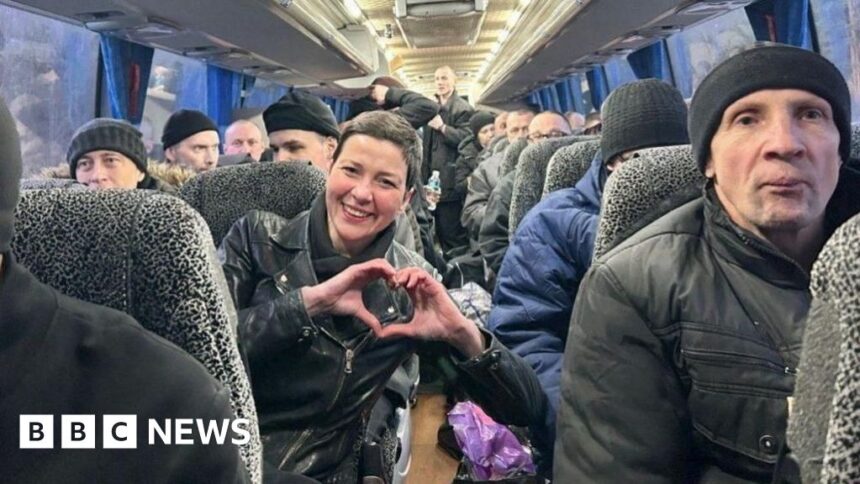
In a significant development for Belarusian politics, 123 political prisoners have been released by President Alexander Lukashenko’s regime, marking a pivotal moment for the country’s opposition movement. This move, widely regarded as influenced by complex negotiations led by the United States, has been celebrated by many who have long campaigned for the freedom of these individuals, including prominent opposition figures, human rights activists, and journalists.
Among those released is Maria Kolesnikova, a well-recognized protest leader known for her vibrant personality and commitment to the opposition. A video capturing her joyous reunion with fellow former prisoners went viral, showcasing her exuberance as she celebrated regained freedom. “It’s a feeling of incredible happiness to see those who are dear to me… and realize we are all free,” Kolesnikova stated, emphasizing her gratitude to supporters. Despite her exuberance, she also voiced solidarity with those still imprisoned, expressing hope for collective freedom.
Accompanying Kolesnikova in the list of released prisoners is Viktor Babaryka, a banker who attempted to run for president in 2020 but was incarcerated before elections could commence. The notable Ales Bialiatski, a Nobel Peace Prize laureate, was also released after serving a 10-year sentence. All three faced imprisonment due to their opposition to Lukashenko’s authoritarian rule, particularly in response to the widespread protests following the disputed 2020 elections.
The negotiations leading up to this release were reportedly intricate and included a notable visit to Minsk by John Coale, the special envoy for former President Donald Trump. For Lukashenko, this détente represents a significant diplomatic win, allowing him to ease his long-standing pariah status in the West. In return, the U.S. lifted sanctions on potash, a crucial export for Belarus, further highlighting the transactional nature of international relations in this context. However, the European Union maintains stricter penalties against Lukashenko’s regime.
The released prisoners were expected to gather in Vilnius, Lithuania, where supporters braved the cold to await their arrival, some holding the red and white opposition flag as an emblem of their struggle. Kolesnikova’s sister, Tatsiana Khomich, expressed her overwhelming joy at her sister’s freedom after years of campaigning for her release. Kolesnikova had spent much of her incarceration in solitary confinement, making her homecoming particularly poignant.
As the crowd waited alongside the U.S. embassy, a convoy of vehicles approached, creating a stir among supporters. However, it became apparent that only a fraction of the released prisoners had been transported to Lithuania; many, including Kolesnikova, were diverted to Ukraine—a move interpreted by some opposition leaders as a final maneuver by Lukashenko to manipulate the situation.
Bialiatski, amid cheers from the crowd after emerging from the embassy, recalled the emotional whirlwind of his release, still adjusting to life outside prison after four years of confinement. He emphasized the importance of continuing to advocate for the many political prisoners who remain behind bars in Belarus, underscoring the ongoing struggle for justice and democracy in the country.
In a message to Belarusians, Bialiatski rallied for perseverance in activism, stating, “Optimism and activism—never give up!” as he lifted the symbolic flag. His words echoed the hope and resilience felt by many in the opposition movement, reaffirming their commitment to securing freedom for all who still suffer under Lukashenko’s regime.