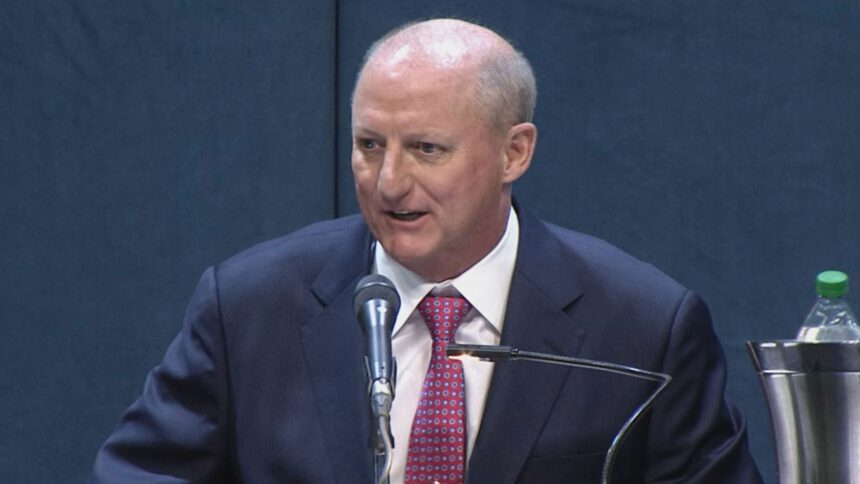
In his inaugural annual shareholder letter as CEO of Berkshire Hathaway, Greg Abel sought to reassure investors about the continuity and core principles of the conglomerate under his leadership. In a message that underscored his respect for the legacy of Warren Buffett, who remains as chairman, Abel expressed humility at stepping into such a significant role.
“I am honored by our Board’s decision to appoint me CEO of Berkshire and humbled to succeed Warren as I write my first annual letter to you,” Abel wrote, acknowledging the challenge of following in Buffett’s footsteps. At 63 years old, Abel indicated that his leadership would be anchored in the financial conservatism and disciplined investing philosophies that have become hallmarks of the Berkshire brand.
Abel outlined his commitment to maintaining the company’s financial strength and capital discipline, emphasizing the importance of a “fortress-like balance sheet” that ensures the resilience of the firm in times of uncertainty. He noted that Berkshire’s cash reserves stood at an impressive $373.3 billion at the end of 2025, describing this substantial liquidity as “strategic dry powder” that positions the company to seize opportunities without compromising its stability.
Responding to speculation regarding Berkshire’s large cash position, Abel reaffirmed that this did not equate to a retreat from investment activity. He reiterated the company’s longstanding policy against paying dividends, stating that Berkshire would not distribute dividends as long as the potential for generating shareholder value through retained earnings remains significant.
“Overseeing our stock portfolio, we apply the same disciplined framework whether acquiring an entire business, buying public shares, or repurchasing stock,” he wrote. Abel emphasized that Berkshire’s equity investments would remain concentrated in select American firms, including Apple, American Express, Coca-Cola, and Moody’s. Notably absent from this prominent list was Bank of America, previously a significant holding.
Abel also clarified his leadership role in monitoring the equity portfolio, stating that he would directly oversee this important aspect of capital allocation, while Ted Weschler would continue to manage a portion of the investments.
With a hands-on approach, Abel has spent 25 years at Berkshire, having originally joined the company following its acquisition of MidAmerican Energy, where he later served as CEO. He expressed his commitment to long-term stewardship, recognizing the enduring nature of Berkshire’s ownership structure.
“Our owners’ time horizon extends beyond the tenure of any individual CEO,” he wrote, acknowledging his own limitations while projecting confidence in Berkshire’s future. Abel made it clear that while he may not be in the role for decades like Buffett, he aims to ensure that future generations of shareholders will see a strengthened company.
Abel also distanced Berkshire from the typical Wall Street emphasis on quarterly earnings reports, stating, “We concentrate on quality, not frequency.” He assured shareholders that significant updates would be communicated as necessary, rather than fitting into a rigid quarterly framework.
Overall, Abel’s communication laid a foundation for his leadership style while signaling to investors that the guiding principles that defined Berkshire Hathaway under Buffett would remain firmly intact.