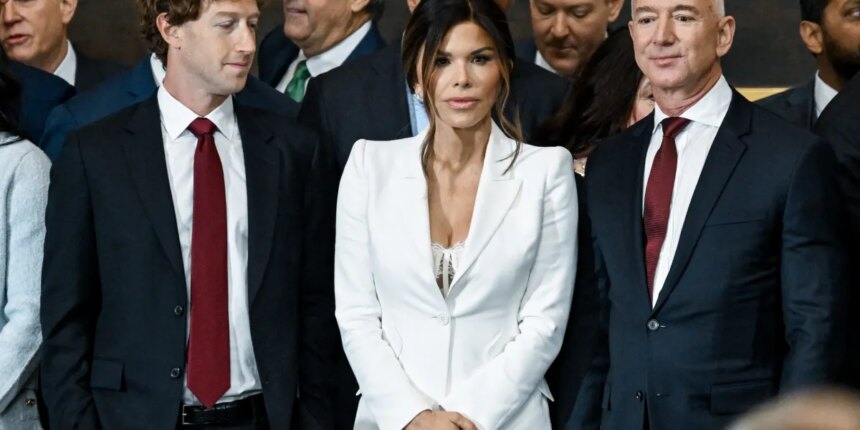
Last week’s downturn in the markets has left many investors concerned about their 401(k) and Roth IRA portfolios, a sentiment echoed even among the wealthiest individuals. Notably, six of the ten richest people globally have witnessed substantial declines in their fortunes, totaling over $255 billion. Among them, Jeff Bezos has seen a decrease of $30.7 billion since January, while Mark Zuckerberg’s wealth has dropped by $46.3 billion, according to Bloomberg’s Billionaire Index. Larry Ellison recorded the sharpest decline, losing $59.6 billion, bringing his net worth down to $188 billion—considerably lower than his peak of $400 billion last September.
The steep losses correlate closely with market performance, as stocks of prominent companies struggle this year. Amazon shares are down nearly 11%, Meta has slumped about 18%, and Oracle’s stock has plummeted nearly 30%. The so-called “Magnificent Seven,” which includes major players such as Alphabet, Apple, Tesla, Microsoft, and Nvidia, has all seen their stock values drop by double digits from their respective 52-week highs.
Several factors contribute to this market downturn, including ongoing geopolitical tensions like the conflict with Iran and growing skepticism regarding the sustainability of the AI-driven stock rally. Last week’s selloff alone resulted in a 3% drop for the S&P 500, further pushing the Dow into correction territory and compounding what has already been a tumultuous year for equities.
However, the financial landscape remains uneven among billionaires. Not all are experiencing losses; individuals like Elon Musk, Michael Dell, and members of the Walton family have actually increased their wealth this year.
Despite recent fluctuations, billionaire wealth continues to reach unprecedented heights. According to Oxfam, total billionaire wealth is projected to hit $18.3 trillion in 2025, marking a 16% increase that is three times faster than the five-year average. Since 2020, wealth among the ultra-rich has surged by 81%. This surge remains concentrated at the top, with the wealth of the ten richest Americans—predominantly tech innovators—growing by $698 billion from November 2024 to November 2025.
Such disparities are becoming increasingly apparent, as the richest 0.1% in the U.S. own approximately a quarter of all equities, while the bottom half hold only 1.1%. This widening wealth gap is shifting public opinion on wealth redistribution. In 1998, 45% of Americans supported increasing taxes on the wealthy. By 2022, that number had climbed to 52%, according to Gallup.
Yet, critiques of the ultra-wealthy are not universally accepted. Rapper Jay-Z, whose net worth stands at an estimated $2.8 billion, challenged the notion of demonizing billionaires, calling it a “cop-out.” He emphasized the need to address the broader systemic issues that contribute to wealth inequality.
While many billionaires have committed to the Giving Pledge, promising to donate at least 50% of their wealth to charitable causes, critics argue that the reality of philanthropic giving is far more complex. Liz Baker, CEO of Greater Good Charities, highlighted the substantial challenges involved in deploying large sums effectively to resolve intricate global issues. “It’s hard,” she remarked, “because there’s a really big responsibility that goes with that. You can’t just go at a problem and be like, here’s a billion dollars, figure out the problem.” This underscores that meaningful charitable efforts require not just wealth but also careful planning and strategy to make a genuine impact.