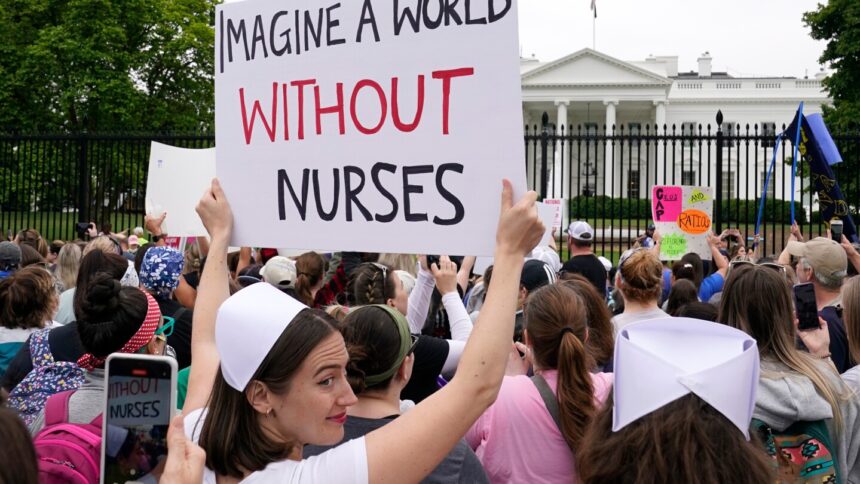
A bipartisan coalition in Congress is pressing the Education Department to classify nursing as a “professional” program, in response to widespread concern after the omission of nursing from a recent agency definition. The list of professional fields previously established by the Trump administration includes areas such as medicine, law, and theology, but notably excludes nursing and other vital professions advocated for by industry groups.
The designation of “professional” would significantly benefit nursing students by allowing them to access larger federal loan amounts for graduate degrees. Under the proposed rules, students enrolled in professional programs could borrow up to $200,000 total for their degrees, and $50,000 annually, as opposed to the $100,000 total and $20,500 annual caps imposed on other graduate programs. Historically, graduate students have been able to secure federal loans covering the entirety of their program costs.
In a letter sent on Friday, the lawmakers contended that the existing $100,000 cap on nursing graduate programs impedes students aspiring to enter high-demand fields like nurse anesthesia. They emphasized that many year-round nurse practitioner programs can surpass costs of $20,500 annually, further burdening students financially.
In response to inquiries, the Education Department referred to earlier comments indicating that 95% of nursing students are enrolled in programs not impacted by the new caps. However, the lawmakers highlighted that certified nurse anesthetist programs can exceed $200,000 in cost, noting that these programs significantly benefit healthcare delivery, particularly in rural and underserved communities where more expensive physician alternatives may not be available.
The letter garnered support from more than 140 lawmakers, including a dozen Republicans, and was spearheaded by leaders of the Senate and House nursing caucuses. Additionally, Representative Ritchie Torres from New York sent a parallel letter emphasizing that excluding nursing students from the professional designation could force them to seek higher-risk private loans or abandon their educational pursuits altogether. Torres expressed concern over how this restriction would adversely affect low-income, first-generation, and immigrant students in his district.
The Trump administration has justified the new caps by asserting that they would motivate colleges to decrease tuition prices. The criteria for determining professional degrees were based on a 1965 law regarding student financial aid, which offers examples of professional programs but does not explicitly limit the definition to those fields alone. The agency’s current definition includes pharmacy, dentistry, veterinary medicine, chiropractic, law, medicine, optometry, osteopathic medicine, podiatry, theology, and clinical psychology.
The decision has faced backlash from both nursing organizations and additional industry groups, such as physical therapists and social workers, that also feel unjustly excluded. Education Department officials have indicated that further revisions may occur as the rule-making process advances toward finalization.