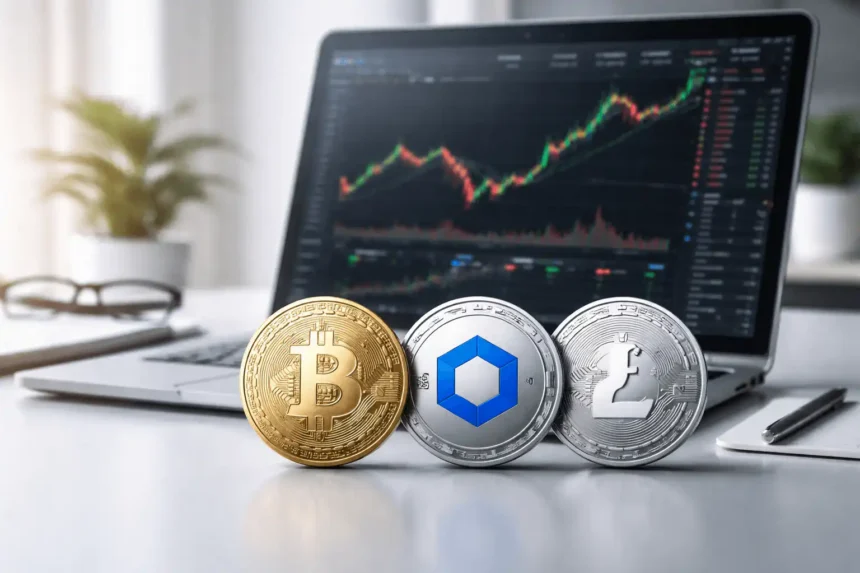
The digital asset landscape is witnessing a significant shift as Bitcoin, Chainlink, and Litecoin each carve out their unique positions in the market.
Bitcoin (BTC) is currently riding a wave of institutional support, bolstered by remarkable inflows into U.S. spot ETFs, which have surpassed $1 billion in a matter of days. This influx of capital has reaffirmed Bitcoin’s status as the “digital gold” within modern investment portfolios, further solidifying its role as a hedge against economic uncertainty. On-chain metrics suggest a bullish outlook, as recent data indicates a migration of approximately 13,500 BTC to private custody within a week, hinting at a “supply shock” that could lead to future price appreciation. However, Bitcoin’s price remains somewhat volatile, fluctuating between $69,000 and $71,000 as it navigates a consolidation range between $62,800 and $72,600.
In contrast, Chainlink (LINK) serves as the backbone of the tokenized economy, providing essential data services across various decentralized finance (DeFi) protocols. The token has remained resilient, trading between $9 and $10 as it gears up for potential growth in Real-World Assets (RWAs). Chainlink’s critical role in bridging blockchains with external data could see it become an integral component of the financial ecosystem, especially as major institutions explore its Cross-Chain Interoperability Protocol (CCIP).
Litecoin (LTC), often referred to as the “silver” to Bitcoin’s “gold,” continues to fulfill its promise of fast and low-cost transactions, processing blocks four times quicker than Bitcoin. With transaction fees typically below $0.01, Litecoin remains an attractive option for users looking for a practical alternative for everyday commerce. Despite its longevity and reliability, Litecoin’s price dynamics closely mirror those of Bitcoin, limiting its appeal among speculators seeking substantial gains.
As investors weigh their options, Bitcoin is viewed as the safest bet for those seeking risk-adjusted returns, enhanced by its institutional backing and liquidity. Chainlink appeals to long-term visionaries looking to capitalize on the expanding RWA market, while Litecoin caters to those prioritizing utility in digital payments.
In summary, for a well-rounded portfolio approach, Bitcoin may stand out as the core holding due to its substantial institutional adoption and liquidity, with Chainlink offering high-upside exposure in a rapidly-evolving financial landscape, and Litecoin providing a stable, low-cost payment solution. Each token offers distinct value propositions that may suit different investor strategies, highlighting the importance of diversification in navigating the current crypto market.