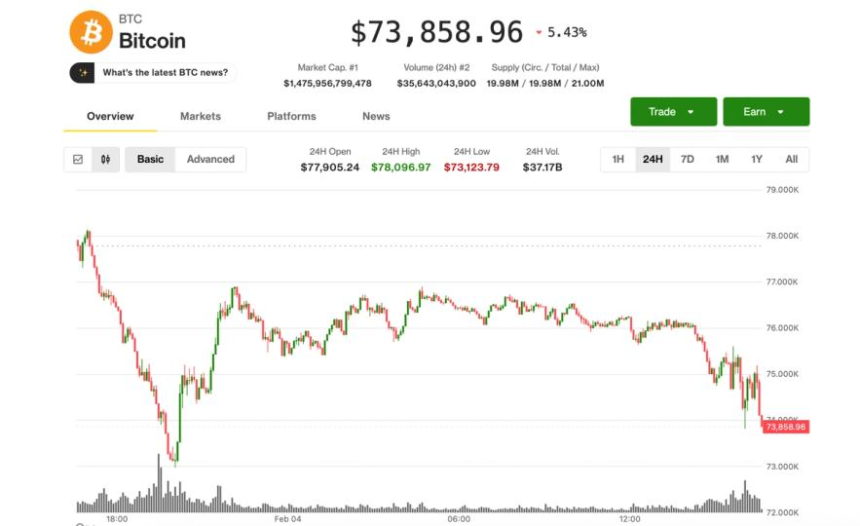
Bitcoin fell back below $74,000 during the early part of the U.S. trading session, reversing a brief recovery that had taken place after reaching lows on Tuesday. The drop was attributed to ongoing weakness in the tech sector, where the Nasdaq 100 index recorded a 1% decline, following a more substantial 1.5% drop the previous day. The software segment was particularly hard hit, with the iShares Expanded Tech-Software ETF (IGV) tumbling by 4%, exacerbating an already significant 17% decline over the past week, amid growing concerns that advancements in artificial intelligence (AI) could lead to considerable disruption.
The struggles of crypto miners also mirrored the broader market downturn. Companies such as Cipher Mining (CIFR), IREN, and Hut 8 (HUT) saw their stock prices dip by more than 10%. These declines followed disappointing news from chipmaker AMD, which experienced a staggering 14% drop in its stock value after presenting a 2026 outlook that fell short of analysts’ expectations.
In addition to the cryptocurrency market, gold prices faced setbacks as well. After an initial surge to $5,113 per ounce overnight, the precious metal quickly slid back below $5,000 as investor sentiment continued to shift.
Economic indicators released recently provided a mixed picture. The ISM Services PMI for January remained steady at 53.8, matching December’s revised figures and slightly exceeding expectations, suggesting ongoing expansion within the services sector. In contrast, private job growth experienced a significant slowdown, with only 22,000 jobs added according to an ADP report. This figure fell well below the forecast of 48,000 and also trailed December’s lackluster addition of 37,000 jobs.
Normally, the government’s January job report would be released on the upcoming Friday; however, a recent short government shutdown has pushed back its publication until next week. Quinn Thompson, Chief Investment Officer at Lekker Capital, commented on the job market’s challenges, noting that “Manufacturing has lost jobs every month since March 2024,” and further highlighted that “this month, professional and business services and large employers joined the weakness.” Thompson believes that markets may be underestimating the potential for increased Federal Reserve stimulus anticipated for 2026.