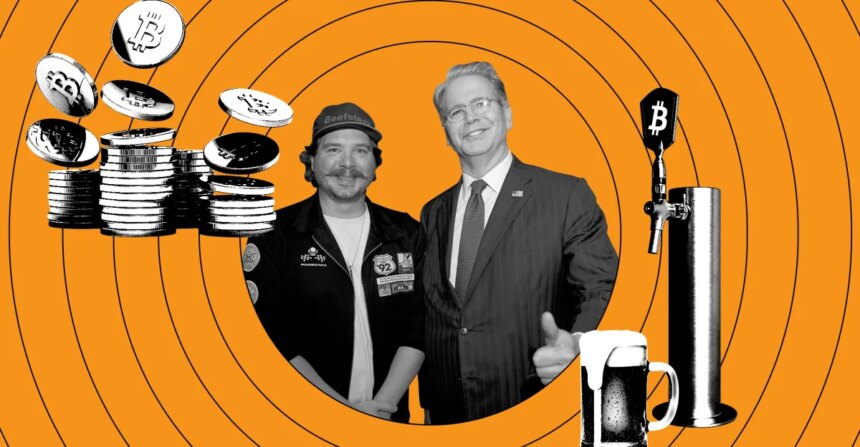
In a striking juxtaposition to the traditional political landscape of Washington, DC, the introduction of Pubkey—an unconventional dive bar themed around Bitcoin—has stirred considerable interest and skepticism. The bar, which originated in New York City, marks a bold entry into an area long dominated by corporate lobbying and government officials, particularly on K Street. Known for its carefully curated atmosphere, Pubkey aims to foster a unique social environment that contrasts sharply with the formalities of DC’s political culture.
Spurred by the increasing polarization surrounding cryptocurrency regulation, Pubkey’s founder, Thomas Pacchia, envisions the bar as a venue for building connections and bridging divides. While the Biden administration pursues policies to regulate the crypto industry, Pacchia hopes to leverage the casual setting of Pubkey to invite both Democratic and Republican lawmakers into conversations surrounding Bitcoin. He asserts that through social engagement rather than conventional lobbying, Pubkey can reshape perceptions and cultivate an understanding of Bitcoin among lawmakers.
However, reactions from the local community reflect substantial skepticism about the establishment’s viability. A commentary from a local news site posed the question: “Raise your hand if you plan to never set foot in there,” highlighting the ambivalence felt by many residents toward cryptocurrency and its associated culture. This antipathy is further compounded by increasing scrutiny from government agencies, particularly in light of high-profile cases of fraud and financial misconduct linked to the crypto sector.
The inaugural event at Pubkey DC showcased a vibrant mixture of the unconventional and the political. Attendees included a range of notable figures—from lawmakers to local influencers— mingling amidst mariachi bands and festive décor. The event featured curious attractions such as a portrait of Pepe the Frog dressed as Napoleon and live electric music, contributing to a lively atmosphere. While Pubkey’s first mission is clear—to promote Bitcoin and its community—a deeper intention resides in altering the prevailing narrative surrounding cryptocurrency.
Notably, the bar shares a space with the Bitcoin Policy Institute, a think tank dedicated to researching Bitcoin’s societal implications, which operates discreetly behind the bar. Such a cohabitation exemplifies the underlying ambition of Pubkey: to normalize Bitcoin culture within political discussions and provide stakeholders with a platform for dialogue often found in more formalized settings.
Despite its seemingly idealistic approach, Pubkey is not devoid of challenges in a city where political alignment intensifies division. Critics question whether a bar can genuinely function as a bipartisan hub when the ideological rifts are so pronounced. Historical attempts at creating cross-party spaces, such as the short-lived Political Pattie’s, serve as reminders of the difficulties faced in fostering bipartisan engagement in today’s climate.
Nevertheless, Pacchia remains hopeful. He emphasizes that Pubkey aims to integrate elements of Bitcoin culture into the mainstream political framework without the baggage that often accompanies it, such as its notorious associations with illicit activities. This ambition hinges on attracting a diverse clientele that includes not only crypto enthusiasts but also those who may be indifferent or skeptical of the cryptocurrency landscape.
Ultimately, Pubkey stands at the intersection of cryptocurrency advocacy and social engagement, aiming to create a space where lawmakers and citizens alike can explore the issues surrounding Bitcoin. Through careful curation of events, accessibility, and a commitment to fostering community discussions, Pacchia aspires to reshape the narrative and bring credence to Bitcoin—not just as a financial instrument, but as a cultural phenomenon worthy of consideration in contemporary political discourse. Whether Pubkey can successfully navigate DC’s complex political waters remains to be seen, but its arrival certainly adds a new dimension to the city’s evolving social fabric.