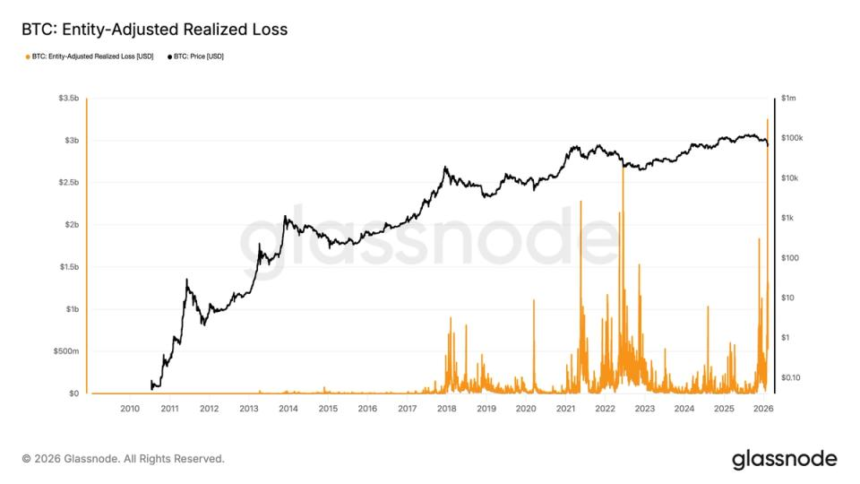
Last week witnessed a historic downturn in the Bitcoin market, marked by an unprecedented financial decline that has reshaped perspectives on cryptocurrency investments. The largest realized loss in Bitcoin history occurred as the digital asset’s value plummeted from a high of $70,000 to a low of $60,000 on February 5. This drastic drop prompted a staggering Entity-Adjusted Realized Loss of $3.2 billion, according to data from Glassnode.
The metric, which specifically quantifies the USD value of coins that were sold below their original acquisition price while excluding internal transactions between the same entities, underscores the magnitude of this market shift. The losses recorded during this recent capitulation surpassed even the bleakest moments of 2022, notably eclipsing the $2.7 billion loss that followed the collapse of LUNA.
Data platform Checkonchain characterized last week’s sell-off as a “textbook capitulation event.” This analysis highlighted that the rapid sell-off transpired under heavy trading volume and effectively crystallized losses from investors with the least conviction in the asset. Daily net losses during this period exceeded $1.5 billion, signaling an alarming trend and establishing this sell-off as the most significant absolute USD loss ever recorded in the network’s history.
Investors are now trying to assess the implications of this downturn, with some viewing it as a potential indicator of a bear market bottom. As of the latest reports, Bitcoin is trading at approximately $67,600, illustrating a slight recovery following the dramatic decline. The events of last week have left many in the crypto community reflecting on market dynamics, investor behavior, and the potential for future volatility in the cryptocurrency landscape.