Bitcoin (BTC) is currently trading at $101,591.91, showing only marginal positive movement year-to-date. This stability indicates that 2025 has been a period of consolidation for the cryptocurrency, maintaining its value around the $100,000 threshold. Recent price fluctuations are believed to be linked to previously dormant Bitcoin coins re-entering the market, as indicated by on-chain data analysis.
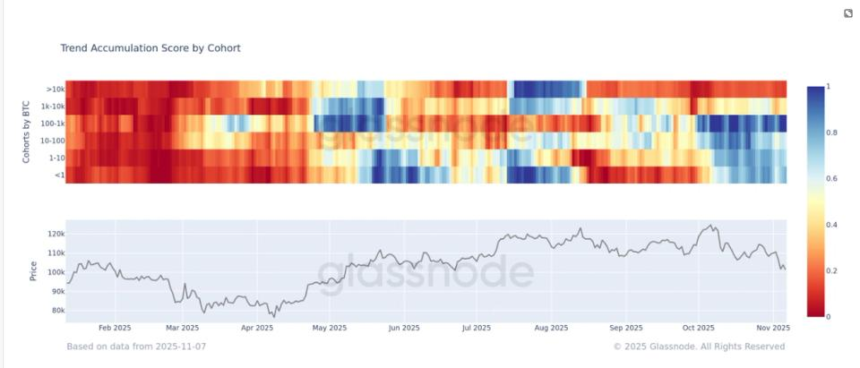
The primary drivers of the current downward price pressure seem to be large holders, known as “whales.” According to Glassnode’s Accumulation Trend Score (ATS), which assesses the accumulation and distribution behaviors across various wallet cohorts, whales have been actively distributing their holdings, contributing to the recent price weakness. The ATS evaluates entities based on the size and volume of Bitcoin they have acquired over a recent 15-day period. A score near 1 suggests active accumulation, while a score near 0 indicates distribution.
Data reveals that whales, defined as those holding over 10,000 BTC, have consistently sold off their holdings since August, marking three months of uninterrupted distribution. In contrast, wallets containing between 1,000 and 10,000 BTC appear neutral, with an ATS score of around 0.5, while smaller wallets holding below 1,000 BTC have shown robust accumulation behavior.
Earlier in the year, particularly during the first four months, all cohort sizes were engaged in significant distribution, contributing to Bitcoin’s 30% decline to $76,000 in April during an event referred to as the “tariff tantrum.” This divide between the actions of large holders and smaller market participants underscores the ongoing influence of whales on Bitcoin’s price dynamics. As the situation unfolds, it appears that the whales continue to play a pivotal role in steering the asset’s market trajectory.