Bitcoin’s price action is currently hovering just above the critical $90,000 mark as the market navigates a pivotal period characterized by tightening consolidation. Despite weeks of price stabilization, the cryptocurrency appears poised for significant volatility, as traders exhibit fragile conviction on both sides. Historical patterns suggest that such prolonged periods of range-bound trading often precede sharp fluctuations in market activity.
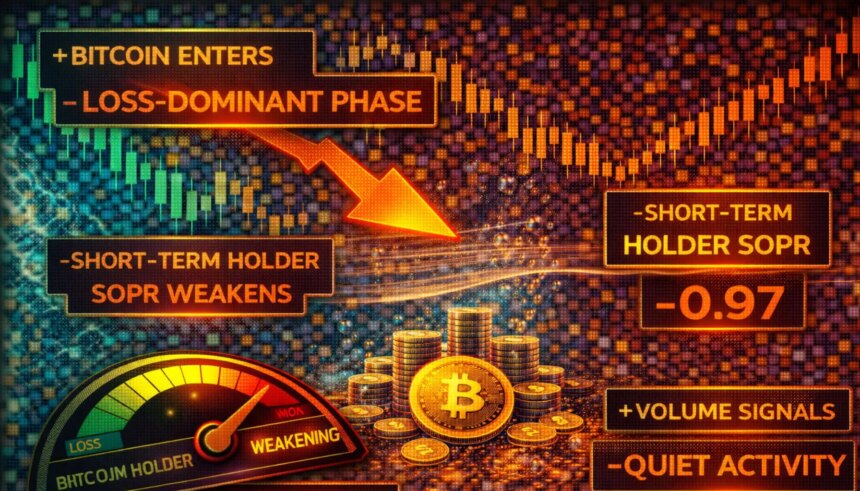
Recent insights from industry analyst Axel Adler Jr. illuminate ongoing trends among short-term Bitcoin holders. Notably, since mid-October 2025, this subset of investors has been consistently liquidating their Bitcoin holdings at a loss. The Spent Output Profit Ratio (SOPR), a key metric that gauges profitability of recent transactions, has languished below the neutral mark of 1.0. This indicates that many transactions are resulting in losses, highlighting a trend of active distribution among those holding Bitcoin for shorter durations.
The repeated underperformance of the SOPR Z-Score, which measures how far current SOPR values deviate from their historical averages, further underscores a persistent environment of loss among short-term holders. The combined signals suggest a disconnect: while the long-term structural framework of Bitcoin remains intact, short-term investors are increasingly capitulating amidst market weakness. The upcoming directional shift for Bitcoin is likely contingent upon whether this selling pressure subsides or intensifies into a more significant market correction.
The latest update on short-term holder behavior, focusing on the SOPR metric, reflects a regime shift toward loss-dominance. As of January 11, the 7-day simple moving average of the SOPR came in at 0.994, with a recent daily reading even dipping to 0.9817, marking the lowest level observed this year. A technical crossover occurred on January 8, when the 7-day average fell below the 30-day average, corroborating the shift toward this loss-centric environment. The current SOPR Z-Score is -0.58, suggesting that SOPR values are trading well below the annual mean—historically a signal of potential local price bottoms rather than a definitive trend reversal.
With this scenario, continued SOPR readings below the neutral point may exert rising psychological and financial pressure on short-term holders, potentially yielding further capitulation. For a meaningful shift in sentiment, the 7-day SOPR would need to surge back above 1.0, aided by a positive Z-Score indicating renewed profitability.
As Bitcoin consolidates around the $90,000 level, the weekly charts portray a market in a state of indecision. After a notable drop from its October highs, Bitcoin has struggled to maintain its footing above the $95,000–$100,000 range. The latest candlestick formations reflect a market lacking strong directional convictions, which aligns with a broader pause in momentum.
From a technical standpoint, Bitcoin continues to remain above its long-term moving averages, with the 200-week moving average still trending upward below the current price. This positioning affirms that the overall uptrend is not yet invalidated. However, with shorter-term moving averages flattening, and current price action falling below these averages, there’s a discernible loss of upside momentum since late 2025.
The prevailing consolidation pattern suggests that, while volatility has diminished following recent sell-offs, market participants are watching closely for signs of renewed demand. As long as Bitcoin sustains above the $88,000–$90,000 support band, the market appears to be taking a breather rather than signaling a complete trend reversal. A breakthrough above the $95,000 level could indicate renewed strength, while any breach below current support levels might usher in a deeper correction.